Invertebrates
See our handy guide to critters found in local homes and our Central Coast Butterfly FAQ. Browse the insects and other terrestrial arthropods we’ve identified. Check out local marine invertebrates, particularly bivalve mollusks and intertidal organisms.
- Anthropology
- Rocks & Fossils
- Invertebrates
- Vertebrates
- Botany
- Astronomy
- Fungi
- General
- Recently Asked
Unusual Marine Organism or Egg Case?
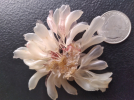
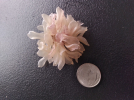
I'm a Ventura resident and found this object (images attached) on the beach the other day. I assume it's some kind of algae, or possibly an emptied egg case, that's been bleached out. The "petals" feel like tough plastic, and are arranged in a sort of rosette. There is also an apparent holdfast with tiny filaments, which should be apparent in the images.
I'm hoping a someone at the center can identify it for me. Any help apprecated.
Thanks,
Brad S.
Ventura, CA
Curator Response
Hi Brad,
Thanks for sharing this neat find with us. It appears to be an emptied egg case of an octopus. Based on the egg size, I would guess it is from Octopus bimaculoides. You can see pictures of egg cases like these being guarded by the female that laid them in this iNaturalist observation by Jeff Goddard at Naples Point on the Gaviota Coast.
Octopus bimaculoides is one of two local species that go by the common name Two-spot Octopus (the other species is Octopus bimaculatus). Both of these species have two beautiful blue rings on the body, often called eyespots because they look a bit like eyes.
Our Museum has a fun history with Octopus bimaculoides and bimaculatus since one of our past curators, Eric Hochberg, Ph.D., helped to find features that distinguish the species based on their eyespot patterns. Before his research, the size of the eggs was the key way people distinguished between the species. You have in hand eggs cases probably made by bimaculoides—the egg cases laid by bimaculatus are generally much smaller. Most of the time people aren't as lucky as you are to see the eggs, so the discovery of a way to tell them apart based on the eyespots was useful. You can see the eyespot differences and read more about these species (and many others) in Cephalopods of the World.
Our sister campus, the Sea Center on Stearns Wharf, usually has a Two-spot Octopus in residence. Sea Center staff made a video about this animal and its habitat that you might enjoy watching if you'd like to learn more.
Thanks again for sharing,
Curator of Invertebrate Zoology Kristen Michaud, Ph.D.