Fungi
Our fungi identifications are courtesy of fungi expert Bob Cummings, who teaches in the Botany Department at Santa Barbara City College in the Biological Sciences. Before you ask, check to see if your fungus has been identified below.
- Anthropology
- Rocks & Fossils
- Invertebrates
- Vertebrates
- Botany
- Astronomy
- Fungi
- General
- Recently Asked
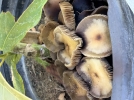
i work a ace hardware and i saw this growing out of the avocado pot
i was wondering if you can tell me what kind of mushroom this is and if it's harmful in anyway
Curator Response
Hi Roman,
We direct all our fungal queries to Bob Cummings, who teaches in the Botany Department at Santa Barbara City College in the Biological Sciences. Here's his response:
"Aha, a 'little brown mushroom.' This is a term of endearment used by mycologists when pushed for an identification among the myriad species that offer only the most subtle differences from each other. Since this is an identification presumably without medical implications, I am willing to offer an 'informed guess.' This is probably a member of the genus Psathyrella, possibly P. piluliformis (aka P. hydrophila, a synonym used in older field guides) based on the hygrophanous nature of the cap (changing color as it dries) and the pallid color of the gills (the gills will become dark grayish brown as the spores mature). The identification must remain tentative for now in light of insufficient information.
Traditional mushroom identification relies on “key characteristics” such as pigmentation, smell, bruising, gill attachment to the stipe, presence or absence of a ring, substrate preference, etc. It is almost impossible for a single photo of a mushroom to reveal all the characteristics a mycologist would be looking for. Additionally, modern mycology has moved beyond morphology-based identifications, to molecular-based, using DNA analyses for more reliable taxonomic and systematic placements.
Psathyrella is saprophytic species (saprophytes are decomposers, as opposed to parasitic or symbiotic species). Many species of saprophytic fungi commonly grow in woody, composted potting soil mixes. Saprophytes do not generally pose a threat to the health of the potted plant. Nor is Psathyrella known to be toxic to humans. However, there are indeed other flower pot fungi that could be parasitic pathogens, and/or could pose the threat of toxicity if ingested. Caution must always be advised when it comes to mushrooms; they are capable of both beneficial and deleterious activities, while at the same time being quite difficult to identify so as to tell which to expect."