Fungi
Our fungi identifications are courtesy of fungi expert Bob Cummings, who teaches in the Botany Department at Santa Barbara City College in the Biological Sciences. Before you ask, check to see if your fungus has been identified below.
- Anthropology
- Rocks & Fossils
- Invertebrates
- Vertebrates
- Botany
- Astronomy
- Fungi
- General
- Recently Asked
Possible Blewit- looking for a second opinion.
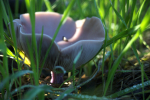
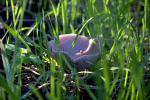
Hello! I am a student at UCSB, and on a recent walk on the lagoon island I found this mushroom. I uploaded it to iNaturalist, and got several Blewit (more specifically Lepista tarda) identifications, however I'm not sure that it is in fact that species. The edges of the cap do *not* fold over like Lepista tarda, and is a lot more concave than the images I have seen of Blewit varieties and other mushrooms found in the Santa Barbara county area.
Curator Response
Hi Sam,
We direct all our fungal queries to Bob Cummings, who teaches in the Botany Department at Santa Barbara City College in the Biological Sciences. Here's his response:
"This is very likely a blewit, Clitocybe nuda (Lepista nuda is an obsolete synonym). There can be quite a bit of variation among individuals of the same species, and the more uplifted cap of this mature specimen would not be a “key characteristic” difference. A bit more information would be needed to rule out some purple lookalikes such as Cortinarius glaucopus, which has a bulbous base, brown spores and is mycorrhizal with our live oaks. Clitocybe nuda lacks a bulbous base, has white (or slightly purplish) spores and grows as a saprophyte in grassy areas but also under live oaks. Cortinarius glaucopus is listed in field guides as “edibility unknown,” and many Cortinarius species are known to be toxic, so it is to be avoided anyway.
Blewits are listed in the field guides as good edibles, but in my experience they are mediocre, some collections tasting okay, others not so much. Furthermore, blewits are reported to cause gastrointestinal upsets in some people. My advice for those wanting to eat wild mushrooms is to make absolute sure of the identity of the mushrooms they intend to eat, by using the “key characteristics” noted in mushroom field guides, not simply looking at a photo in a book, or for that matter, even trusting the word of a "mushroom expert” looking at a photo."