Invertebrates
See our handy guide to critters found in local homes and our Central Coast Butterfly FAQ. Browse the insects and other terrestrial arthropods we’ve identified. Check out local marine invertebrates, particularly bivalve mollusks and intertidal organisms.
- Anthropology
- Rocks & Fossils
- Invertebrates
- Vertebrates
- Botany
- Astronomy
- Fungi
- General
- Recently Asked
What is this creature?
Hello-
My granddaughter and I observed some creatures at minus tide on New year’s day 2026 that I’ve never seen before.
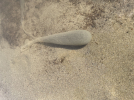
The photo I’m providing does not adequately show the features of the creature. It is gelatinous, very clear, has minimal internal organs, primarily seems to pump water through its balloon-shaped body, has a “head” end that appears to open and a tail end that also appears to open and serves to anchor it in the wet sand
Many (maybe around 100+) of these were anchored in the sand in the minus tide zone vs being carried and deposited like the Velellas or pyrosomes. I’ve never seen them before (in my 70 years of beachcombing)
The one in the photo was pulled from the sand and coated with wet sand because of handling.
Follow-up-
I submitted to iNaturalist and an answer was found: The egg sac of Arenicola cristata, American Lugworm. So glad to learn something new!
Glad to know about this site.
Thank you
Curator Response
Hi Mujiba,
What a cool find. Thank you so much for sharing it with us. We hope lots of tide pooling people on our website see the photo you shared and learn to recognize a polychaete worm’s egg sac!
That is excellent that you uploaded it to iNaturalist. We love that platform for identification, community science, and a springboard to more scientific discovery. Arenicola cristata is an East Coast species that is not likely to be present in Santa Barbara. We see that now the iNaturalist identifications on your observation hover at the family level, identifying it to family Arenicolidae rather than a particular genus or species.
Meanwhile, we reached out through our network in search of a top polychaete expert, and our query made its way to Leslie H. Harris, the senior collections manager for polychaetes at the Natural History Museum of Los Angeles County. Ms. Harris concurs with leaving the identification at family level. She points out that within the family Arenicolidae, "There are two genera (Abarenicola and Arenicola) and several species reported from this coast. They have not been seriously looked at in over 50 years and are in sore need of revision.” (Translation for non-scientists: the distinctions and relationships between these organisms probably need more research to be fully understood.) She noted that the species Abarenicola pacifica is distinctive by its color and has been observed at Shoreline Park, but again, it’s not the only possibility in the area.
Ms. Harris had a fun tip for distinguishing between marine blobs like this: “Polychaete egg masses can be distinguished from similar sea slug egg masses (think bubble snails / order Cephalaspidea) by the arrangement of eggs within the mucus: slug eggs are in strings, polychaete eggs are random.”