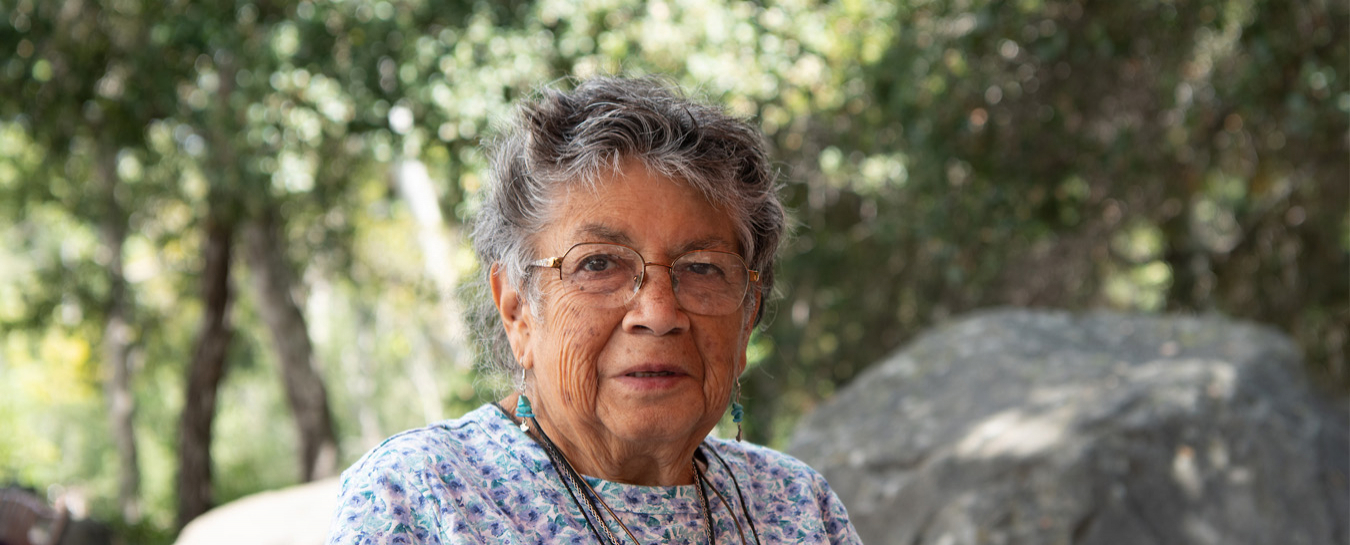
Remembering Ernestine Ygnacio-DeSoto
Chumash Elder Ernestine Ygnacio-DeSoto (1938–2026) was an acknowledged force of nature here in the land of her ancestors. She drew on her uniquely lived expertise to serve as a consultant not only for innumerable cultural institutions in Santa Barbara, but for exhibits at the National Museum of the American Indian and the Natural History Museum of Los Angeles County. Here at the Santa Barbara Museum of Natural History, she was also a longtime research colleague and a friend. We bonded over the foods we loved, gossip at the basketweaving table, and our shared passion for keeping alive the memories and practices indigenous to this part of the world.
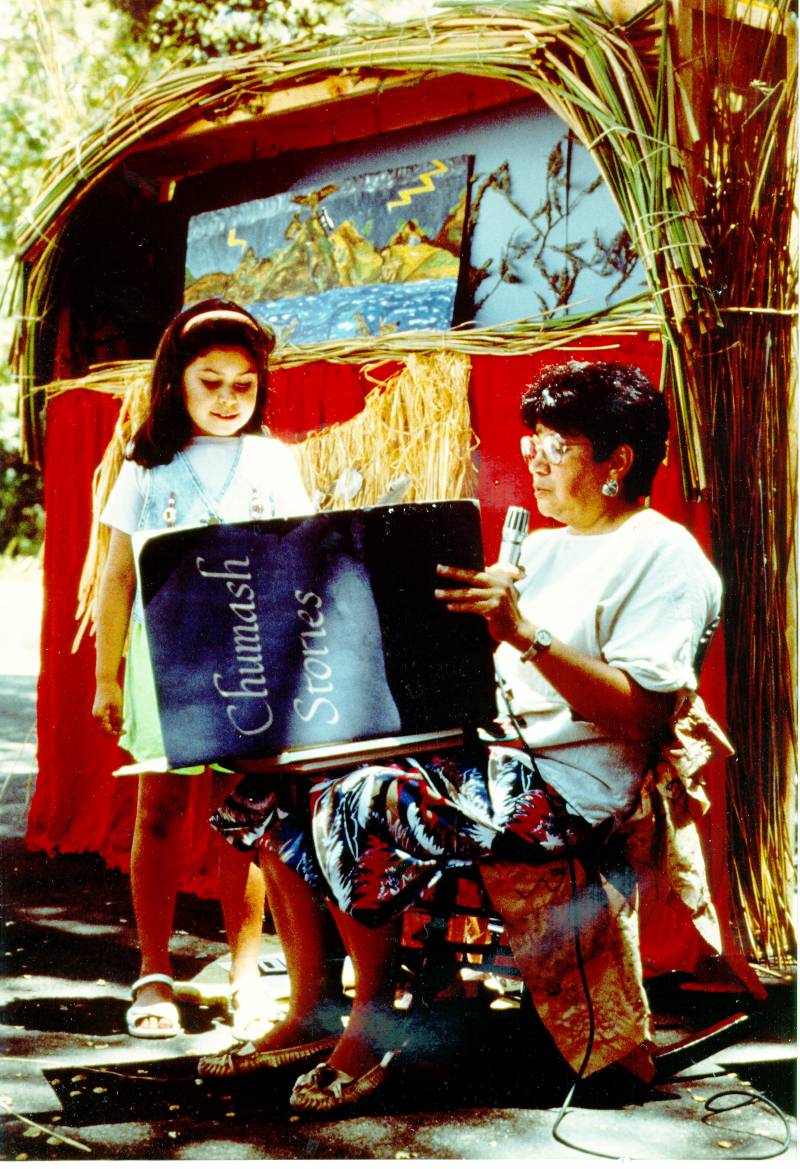
Ernestine reads stories handed down in her family during Chumash Culture Day, a public program at the Museum in 1990. Photo by Ivan Hunter
Ernestine vigorously carried on the work of her foremothers in contributing to the knowledge and life of Chumash cultures. Her mother Mary J. Yee, grandmother Lucrecia Ygnacio Garcia, and great-grandmother Luisa Ygnacio all worked as consultants on Chumash language and cultures to the prolific anthropologist John P. Harrington. Ernestine’s mother Mary was the last person in historic times to grow up speaking a Chumash language as a first language. Thanks in large part to her family’s own efforts, Ernestine lived to see language preservation become language revitalization. Today, Ernestine’s nephew James Yee helps to lead the reawakening of ’alapkaswa’ (also known as Barbareño Chumash, one of several languages in the Chumash language family).
Ernestine began to really focus on her Chumash roots in adulthood, when she already had a family of her own to take care of and plenty on her plate. While studying for her nursing degree, she wrote a biographical essay about her mother for an elective class in American Indian history. Her professor, Kristina Foss, encouraged her to keep researching her ancestors and to consult records at the Santa Barbara Mission Archive-Library. It was there that Ernestine encountered, in her words, a “long-haired, long-bearded, Harrington-looking character”—John Johnson, then a graduate student at UCSB and not yet an anthropology curator at the Museum. He shared information about Ernestine’s ancestors that he had gleaned from mission registers in the course of his dissertation research. It was the beginning of a long and productive research collaboration, sprouting insights that extended from her family tree all the way to the ancient peopling of the Americas. In over 40 years of working together, they grew so close that Ernestine roasted John at his retirement party, saying that beside John’s wife, “I’m the other woman that keeps an eye on him.”
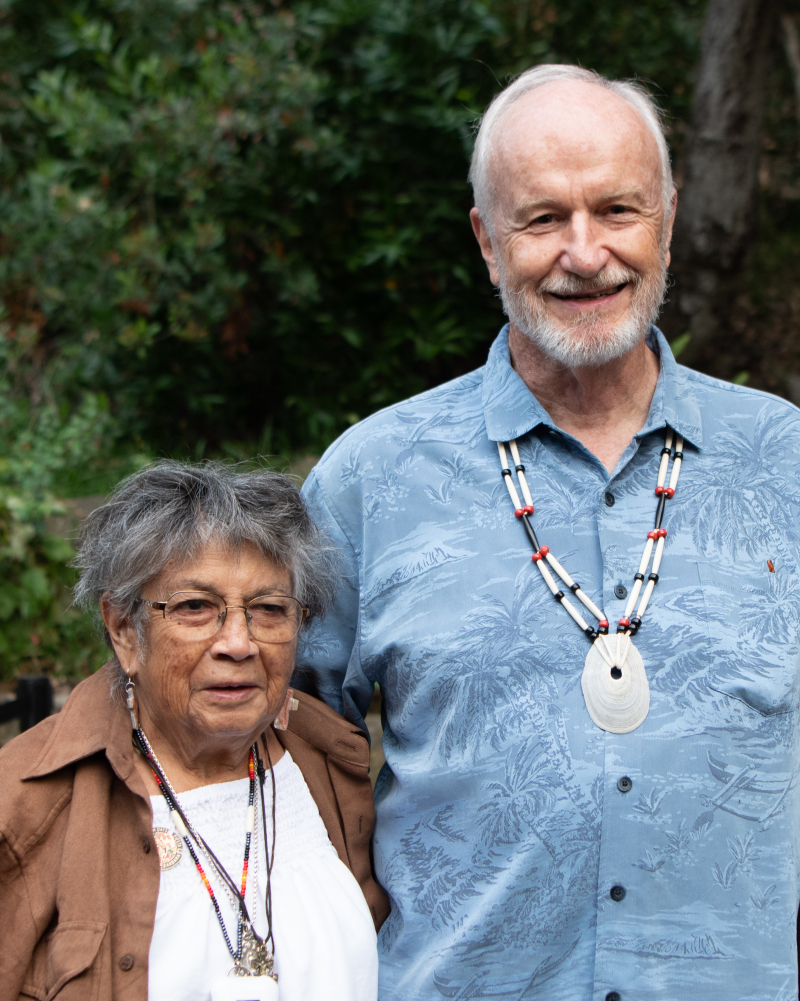
Ernestine and John at his retirement party in 2023
What started with that providential college elective course became a calling Ernestine would tenaciously pursue alongside her busy work and family life. From the 1980s onward, Ernestine grew increasingly involved in Chumash research and cultural preservation, working and consulting with many people. She modeled for the woman pouring water to make acorn mush in the daily life diorama that is still here at the Museum today. She became a dedicated basket weaver in the Chumash style, drawn to the Museum as a hub for the revitalization of those traditions, led here by Anna Campbell, Curator of Ethnography Jan Timbrook, and master weaver Abe Sanchez. A self-described “basket groupie,” Ernestine continued weaving—and encouraging new weavers in Chumash styles—for the rest of her life.
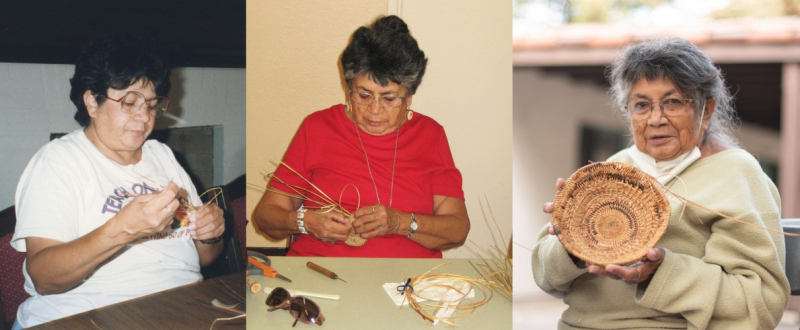
Left, a Museum Archive photo of Ernestine at a basketweaving class here in 1993, working with pine needles—not a traditional Chumash medium, but a classic way for many people to start. Center, working with Juncus in a traditional Chumash style! Right, Ernestine shows her work at an outdoor weaving session at the Museum in fall 2020, when she told us that in her opinion as a former registered nurse, basketweaving had the therapeutic value of “a bottle of Ativan or Valium” with none of the side effects.
Ernestine expanded her focus to statewide meetings such as the California Indian Conference and Breath of Life. At language workshops, she exchanged knowledge with other Indigenous language speakers and linguists, sharing her impeccably accurate memory of the pronunciation and cadences of her mother’s language.
At one conference, Ernestine was inspired by an attendee portraying a California Indian historical figure. This personification spurred her to work with John Johnson to co-write a one-woman script telling the story of women in six generations of Ernestine’s family, dating back to 1769. Ernestine debuted this public presentation at the Santa Barbara Mission Archive-Library, and subsequently brought it to many museums, university classes, and conferences. Eventually it became the documentary 6 Generations: A Chumash Family’s History (directed by Paul Goldsmith). The film debuted here at the Museum in 2009 and aired on PBS station KCET.
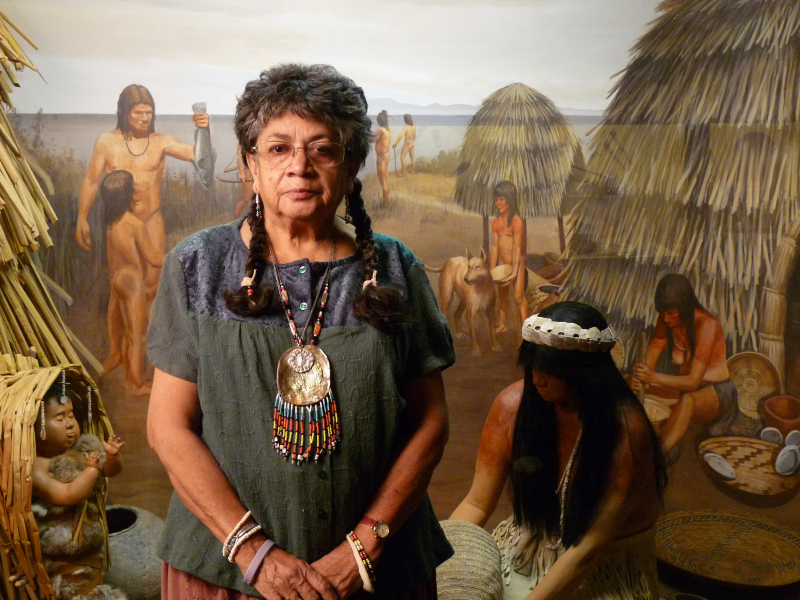
Ernestine proudly represents her ancestors in 6 Generations: A Chumash Family’s History. Photo by Paul Goldsmith
Ernestine served as a trustee on the Museum Board of Trustees and was a founding member of our California Indian Advisory Committee. She collaborated with the Museum on numerous public programs—many organized by Kathleen Conti—and advised us on collection policies. Memorably, she gave the Sukinanik’oy Garden of Chumash Plants its deeply meaningful name.
As the living ethnobotanical exhibit came together about a quarter century ago, Jan Timbrook consulted members of the California Indian Advisory Committee on the plant selections and interpretive signs. The name for the exhibit was still to be determined. “Chumash Garden” could have been misleading, suggesting that the Chumash ancestors traditionally cultivated gardens of confined plantings, rather than a vast store of knowledge and management practices that spanned all the landscapes they inhabited. Something more was needed in the way of a name. In search of possible names for the exhibit, Ernestine went through the notebooks in which her mother Mary Yee had recorded and commented on her work with John P. Harrington. Ernestine’s family was brought into the discussion of possible names in the ’alapkaswa’ language. Everyone agreed on sukinanik’oy, meaning “to bring back to life.” Ernestine said, “because that’s what the Museum is helping us do with our culture”—the highest compliment we could wish to receive.
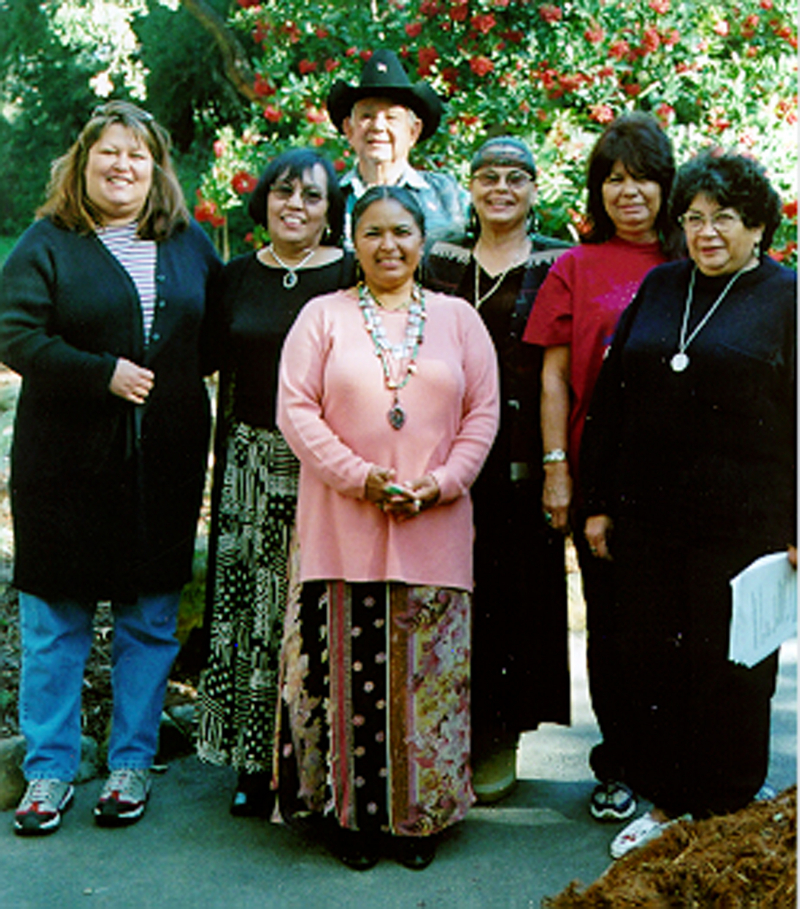
Ernestine stands with other founding members of the Museum’s California Indian Advisory Committee in the early days of the Sukinanik’oy Garden of Chumash Plants. Left to right: Elise Tripp, Beverly Folkes, Julie Tumamait-Stenslie, Art Lopez, Adelina Alva Padilla, Lei Lynn Olivas Odom, Ernestine Ygnacio-DeSoto. Museum Archive photo
Ernestine remained intensely active even in her later years, despite declining health. She worked to preserve San Marcos Open Space, was interviewed in Quechan filmmaker Daniel Golding's 2021 documentary Chasing Voices: The Story of John Peabody Harrington, and brought Chumash expertise and perspective to various projects at UCSB’s North Campus Open Space, personally reigniting cultural burn traditions in 2023. With help from her daughter Gina and friend Kathleen Conti, she usually found a way to join us at the monthly gathering of Central Coast Basketweavers, where she would tell us about her latest work, discuss current events with a mischievous and candid wit, and encourage experts and novices alike to keep on weaving in Chumash styles.
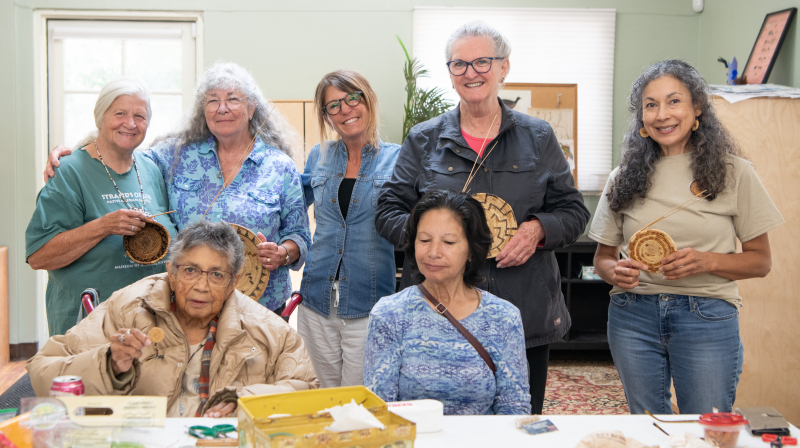
Ernestine holds up the start of a new basket at the Central Coast Basketweavers meeting in August 2025. Left to right: Patricia Anna Campbell, Ernestine Ygnacio-De Soto, Susanne Hammel-Sawyer, guest Romina Cometti, Ernestine’s daughter Gina Unzueta, Jan Timbrook, and Ernestine’s niece Samantha Sandoval
Ernestine’s parting words to her nephew James on the last day of her life were a tender phrase she had memorized from her mother’s language: kaqšwalawiyuw, meaning “I love you all.” When leave-taking or saying goodbye, Ernestine would always use the phrase kiwa’nan, meaning roughly “I go now.” In reply, we would say, “Peleyep hi čʰo,” or “travel well.” So, it is appropriate that we now say “Ernestine, peleyep hi čʰo,” as you join your ancestors in šimilaqša. The Museum is not the same without you, but your work here will endure for generations to come.
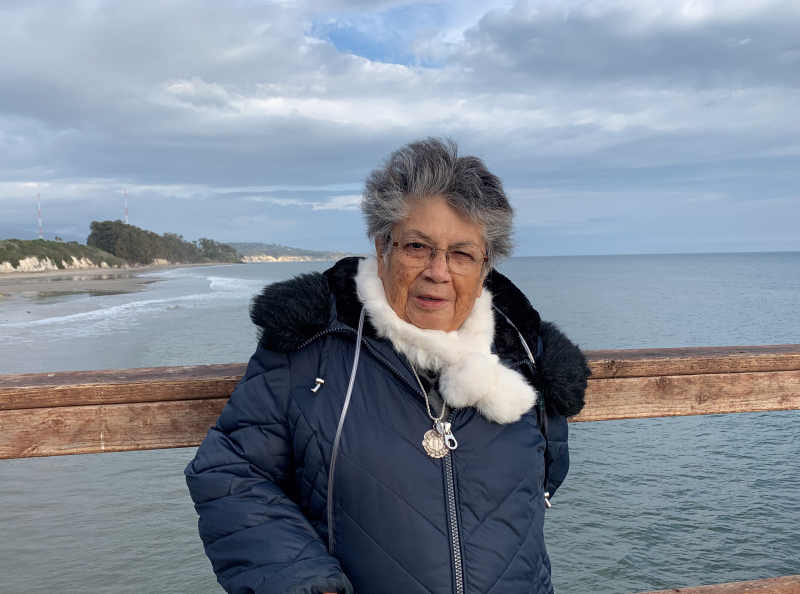
Ernestine at Goleta Pier. Photo by Kathy Conti


0 Comments
Post a Comment