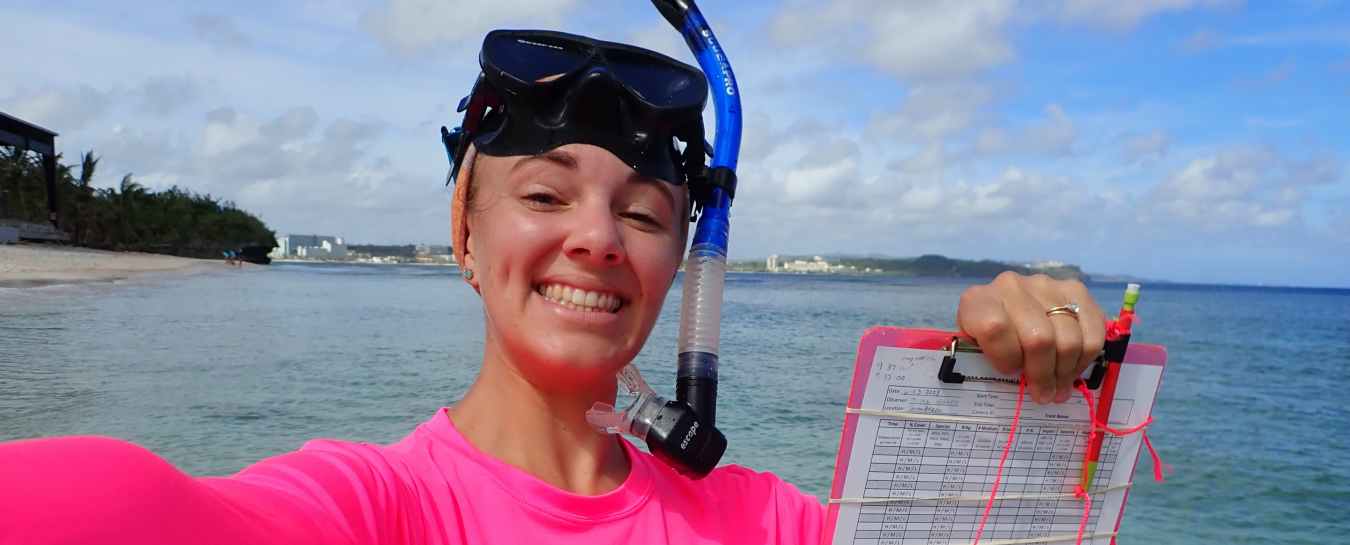
Policy on Guam’s Coral Reefs
While only covering less than 1% of the planet, certain ecosystems are home to 25% of the world’s biodiversity. They are some of the planet’s most precious cargo, and in the midst of global change, they require extra protection.
We call these sanctuaries for life coral reefs. While coral reefs certainly rock, despite a common misconception, they are not just rocks! Coral reefs are living organisms of not just one, but an entire colony of polyps. The polyps work together as one coral structure to feed, reproduce, and secrete their hard skeleton, sustaining life for each other. This essential cooperation is a defining factor of corals, and also of the community of people dedicated to saving our reefs.
Coral Reef Policy and Communications Coordinator for the Guam Coral Reef Initiative, Olivia Bañez, is a Sea Center alumna and member of the coral-reef-saving community: the United States Coral Reef Task Force. Guam is one of the seven places under the United States federal government’s jurisdiction that is home to coral reefs. In her role, Olivia does a little bit of everything, and her favorite part is getting to learn something new every day! She has been working on a broad summary of policies that relate to Guam’s coral reefs, both local and federal; in doing so, she can identify gaps in policy and communicate the benefits and drawbacks of existing policies. Other days, she is working with schools, creating informative brochures, and conducting a range of communications. She works with various audiences, from local youth and fishermen, to Washington, D.C. policy-makers. This kind of outreach is necessary to reach the wide range of people who hold a stake in the United States’ coral reefs, you and I included.
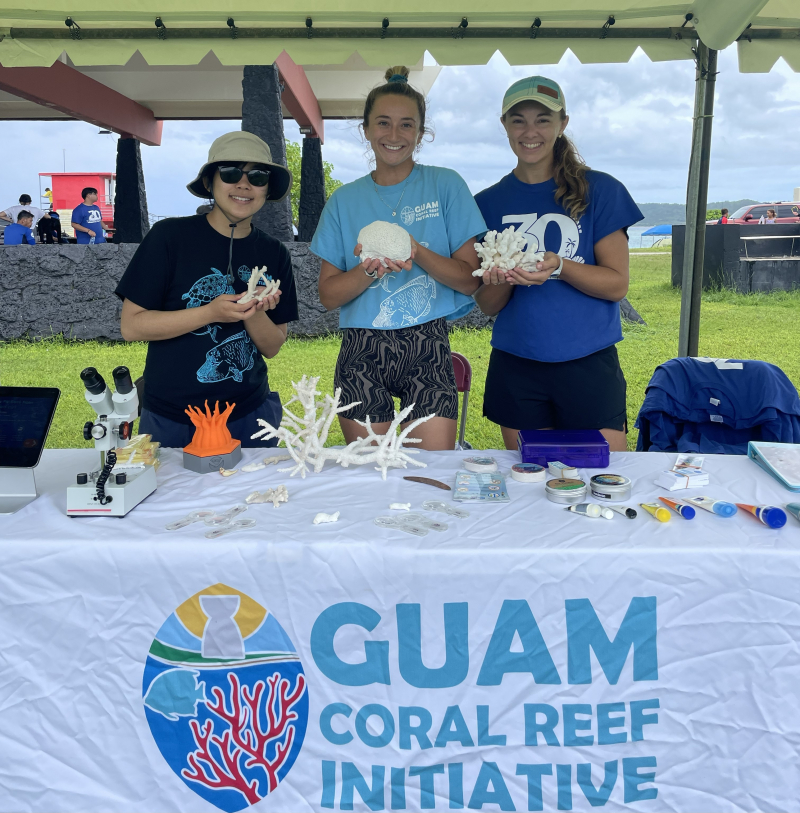
It’s all about teamwork. The Guam Coral Reef Initiative makes a strong effort to engage with all members of the public, like Olivia, right, and her two team members at SandFest 2024. SandFest was a celebration of Guam’s beaches and marine ecosystems. Photo courtesy Olivia Bañez
Part of Olivia’s job is understanding the stakeholders in Guam’s reefs. Stakeholders can be community members who rely on reefs for food, fishermen, or dive shops who require healthy ecosystems to support their businesses, and anyone else with an interest in or concern for coral reefs. Those who live near coral reefs rely on them for one essential service: storm protection. This “ecosystem service” is worth billions of dollars, and helps save coastal communities from destruction. The U.S. Geological Survey estimates that reefs prevent $1.8 billion in damages for the United States each year. Getting to know the island’s stakeholders and local culture on a deeper level is a key aspect of effective communication and policy development. Speaking of the locals who have lived in Guam for generations, Olivia said, “They know more about how to preserve their reef than I do. The local agenda is the most important thing to consider. It’s about getting to know what’s important to people and figuring out where gaps in education exist and how we can fill that. It is very difficult to implement policy that the community doesn’t agree with.” Olivia has been in Guam for three years, and she is learning more and more each day from both the community and her team members.
The U.S. Coral Reef Task Force was established in 1998, so it’s safe to say a lot unfolded before Olivia’s recent arrival. From 2013 to 2017, the waters in Guam reached the hottest on record, causing a massive coral bleaching event, which led to the loss of one third of the corals in the reef. Her team vividly remembers what it felt like to dive through the devastating scene. “We cried in our masks,” they told her, feeling overcome with emotion. This loss of vibrant color is the loss of coral’s symbiotic algae, which enables the coral’s health and survival. The culprit: thermal stress, one of the most damaging effects of climate change. Global problems like climate change are not the only threats to the reef; a large portion of Olivia’s work focuses on reviewing local threats. These include land-based sources of pollution and sedimentation, which can be aggravated by poor building practices. Additionally, human-caused wildfires burn down trees and can weaken root systems that help keep the soil in place and prevent runoff. An influx of nutrients from land to sea causes algal blooms, decreased oxygen, and disruptions to coral communities and food webs.
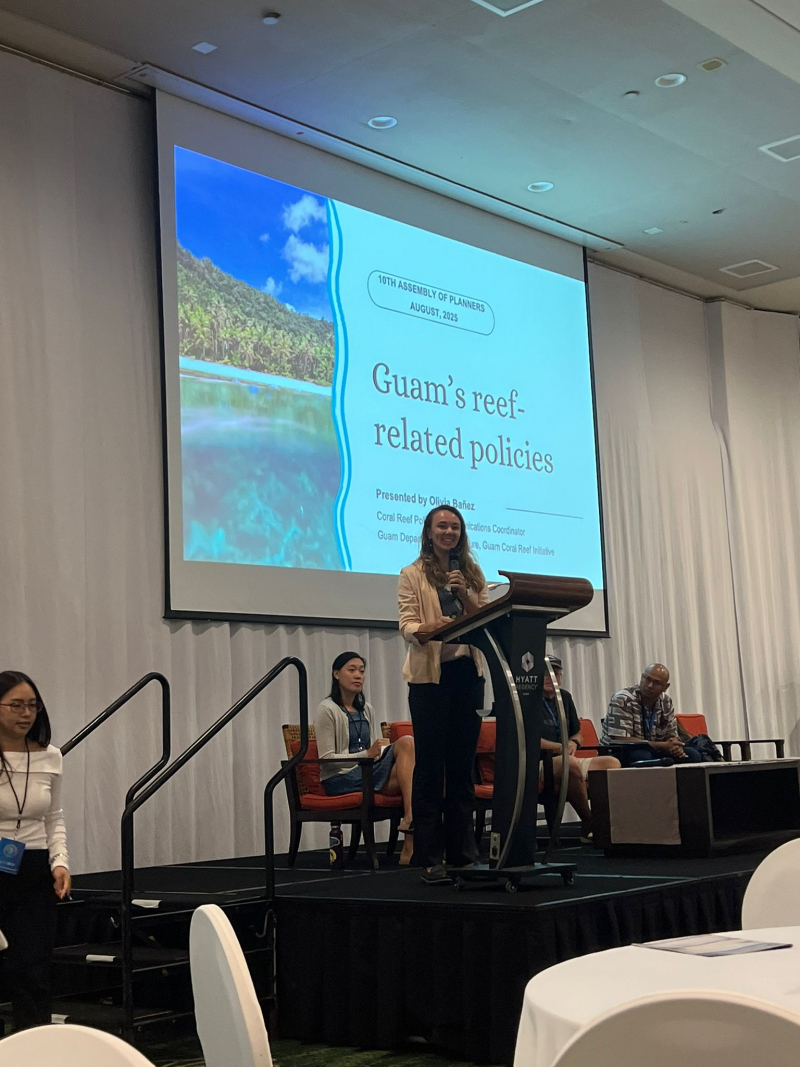
As the coral reef policy and communications coordinator for the Guam Coral Reef Initiative, Olivia conducts various presentations on reef-centered policy and progress. Here she is at the 10th Assembly of Planners Symposium in Guam this past August. Photo courtesy Olivia Bañez
One of the first steps to addressing these issues is education, particularly youth education. For over 12 years, the Guam Coral Reef Initiative has been overseeing the Guardians of the Reef program; this program organizes a training day for student representatives from each public high school to learn about coral reef conservation and education. Following their training, they teach fellow high schoolers what they have learned and work together to visit third grade classrooms around the island. Using skills taught in the Guardians of the Reef training, they teach younger students about coral reef ecology and biology and show children how to protect the reefs through creative presentations and activities. The program creates a ripple effect that expands the audience and gives the future leaders of Guam the resources to make positive decisions for their oceans. The current leaders of environmental policy in the United States also need the resources to implement positive and impactful decisions. This is one of the main roles of the U.S. Coral Reef Task Force, where Olivia co-leads the Communications Working Group. The Task Force brings together coral reef managers, science communicators, policy makers, and more through monthly virtual meetings and bi-annual in-person meetings in locations like Washington, D.C. Through monthly virtual meetings of the Communications Working Group, Olivia says she has received so many helpful ideas from other communications professionals across the U.S. states and territories: “It is a great way to leverage resources that other places have that can help us with our work, and help them with their work.”
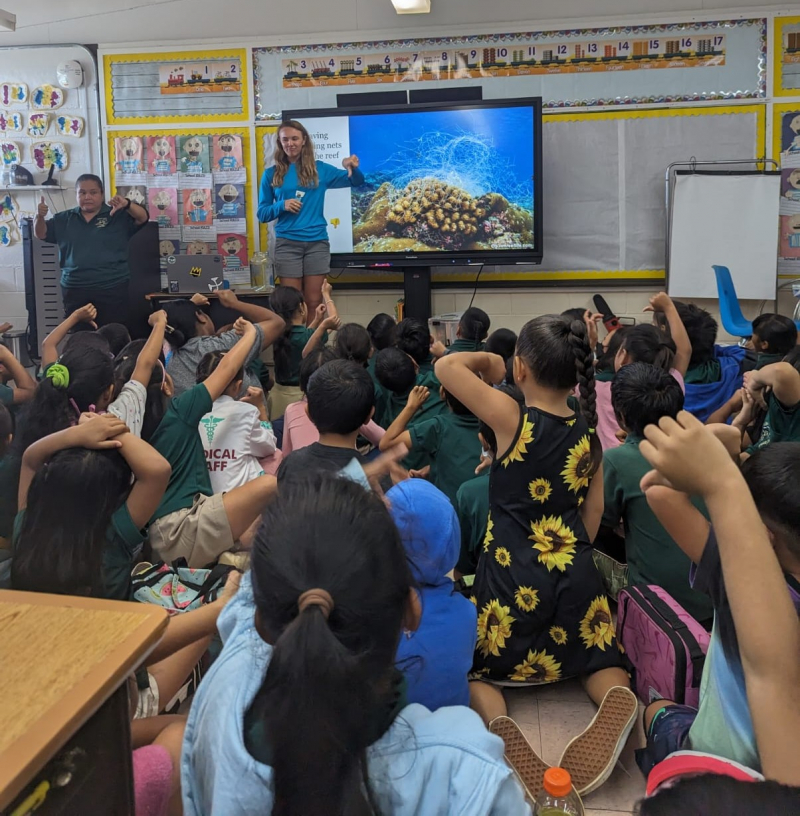
One of Olivia’s many audiences is children, so sharing her passion for corals in classrooms is one of her many duties. Photo courtesy Olivia Bañez
Even with shared resources and productive collaboration, the Guam Coral Reef Initiative still faces the challenge of sustainable funding; all of their work is federally funded by federal agencies and national foundations, with no funding from local sources. With NOAA and other agencies facing a wide range of budget cuts, securing local funding is vital. Olivia has been especially inspired by the team in Hawaii and the recent signing into law of Act 96. Act 96 will increase Hawaii’s existing tourist tax by 0.75%, and the profits from this increase will go directly into funding for green initiatives. Tourist tax isn’t new, but with this new “green” element, it can now quickly raise millions of dollars for environmental protection. While this may not be possible for Guam, this exchange of bright ideas between coral reef teams is what makes the Coral Reef Task Force so brilliant.
Brilliant people working together is magic, and something that Olivia has had the chance to experience. “I’ve hit the jackpot two times,” said Olivia when speaking about her colleagues. The first time was, you guessed it, working at the Sea Center. While on board our team, Olivia was able to try new things, master techniques, and take on daring projects that made her into a strong leader. She learned how to communicate with anyone who could walk through the door, a skill that has certainly served her in her role overseas. “At the Sea Center, l felt like I was working with the coolest people ever.” Now Olivia gets to experience that for a second time, with her all-female team in Guam. Talk about Guam girl power! Taking her knowledge and exceptional interpersonal skills, she has been able to positively contribute to her team in Guam. Wherever she goes, her motto is simple: “Communicate with joy.”
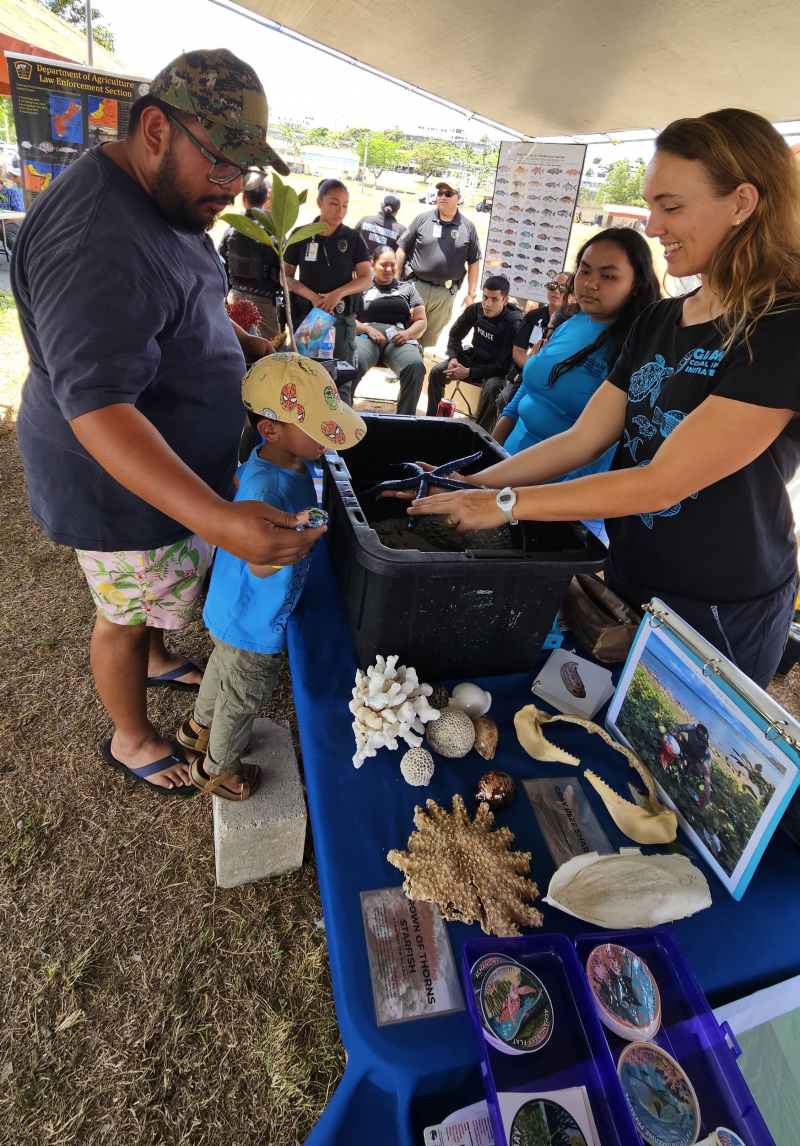
The “two-finger touch” is a classic Sea Center technique Olivia has shared with families in Guam. It helps keep animals like this sea star safe and unharmed. Photo courtesy Olivia Bañez
Olivia’s joy for ocean education began with her own youthful curiosity. Listening to the car radio in high school, she heard that we know more about the surface of the Moon than we know about the ocean floor. Turning up the volume, she wondered how that could possibly be true! When she discusses the reef with people today, she too generates curiosity; turning up the volume for others, she meets listeners with energy and information. Sometimes, she says, you just have to take it slow. In Guam, there is more ocean fear than one may anticipate. Olivia highlights the beauty of the ocean and positive stories and experiences to dispel this fear. Her team has even created virtual field trips so that children and adults can experience the calming wonder of the ocean from wherever they may be. Providing information and resources is a powerful tool for implementing change in Guam. As a recent reef-safe sunblock law goes into effect, local education behind the scenes has been an important first step. Making these connections with the community is essential for preserving a diversity of voices. Just as the reef requires a delicate balance of light, oxygen, and nutrients, policy requires a delicate balance of communication, respect, and openness.
Looking to the future, Olivia would love to continue a career in policy, particularly that involving marine protected areas, or MPAs. They are one of conservationists’ best tools against threats to important ecosystems. Just off our coast here in Santa Barbara, there are 13 MPAs within the Channel Islands National Marine Sanctuary. Over 28 years ago, when Guam’s five preserves were designated, there was a lot of pushback; Olivia is highly interested in understanding why there is pushback to marine preserves and what we can do to find common ground. For now, Olivia will continue sharing her talents with Guam, playing a part in protecting the reefs and communicating with joy!
This is the third article in a series about Sea Center volunteers and staff who've gone on to great things in marine science and advocacy; read The White Abalone Midwife and Tidying Up Our Tides for more.
About the Author
Fiona Diskin is a 2025 aquatic biology graduate from UC Santa Barbara. In addition to her BS in aquatic biology, she also received minors in professional writing in science communication, and theater. Originally from Philadelphia, PA, she found a home here in Santa Barbara, and fell in love with the local marine ecosystems. Currently, she is teaching middle school science on Coronado Island, bringing her love of the ocean to the classroom. She hopes to continue a full- time career in science communication and education, and eventually pursue a graduate degree in marine science. Her favorite marine animal is a close tie between the Moon Jelly and the Bottlenose Dolphin.



1 Comment
Post a CommentHafa Adai Todo Mauleg. My love for Guam and the reef near Talofofo run deep.