From Bears to Woodrats on Her Winding Journey to Curation
an interview with new Curator of Mammalogy, Ally Coconis, Ph.D.
Owen: How did mammalogy become your focus?
Ally: A love of nature was innate, but I think a focus on mammals came from a mix of opportunity and great mentors. The spark that lit the fire was an internship for wildlife management in Yosemite National Park where the focus is on human-wildlife conflict with bears.
Up until 1971, they had open pits of food to attract bears so visitors could view them, which created a bad cycle of bears learning to get food from humans. In response, over the years Yosemite developed one of the best programs to reduce bear/human conflict. Obviously, we still want to see bears, but at a safe distance and in their natural habitat. So sometimes I was talking to visitors, and sometimes I was shooing bears out of campgrounds. I spent several summers in Yosemite, both in the bear program, and later catching and tracking chipmunks in the high country using radio telemetry.
Owen: You did a lot of field technician work very early in your career!
Ally: Yes, it was a great way to get experience and hone in on my particular interests. Another seasonal field job lead me to the Bay Area where I worked for a Ph.D. student studying large mammal habitat use in the wildlife-urban interface. Shout out to the hard-working field techs out there, whose hardiness and persistence is the reason we have such great data on many of these projects. It takes really passionate humans doing this kind of work.
Owen: Your involvement in education makes you stand out as a scientist. How did that develop?
Ally: I had really enjoyed the education component of my work in Yosemite, so I was looking for more of that. Right after I graduated with my undergrad from the University of Utah, I started working at the Natural History Museum of Utah (NHMU). There was an opening in community outreach, and I took a role that had me constantly traveling around the state, tabling about 100 events a year. Part of this work included moving a traveling exhibit that took me all over Utah—talking to the hunters, fishermen, ATVers, hikers, birders and the like—it was cool to talk to a diverse group of outdoor enthusiasts and hear how they connect to nature!
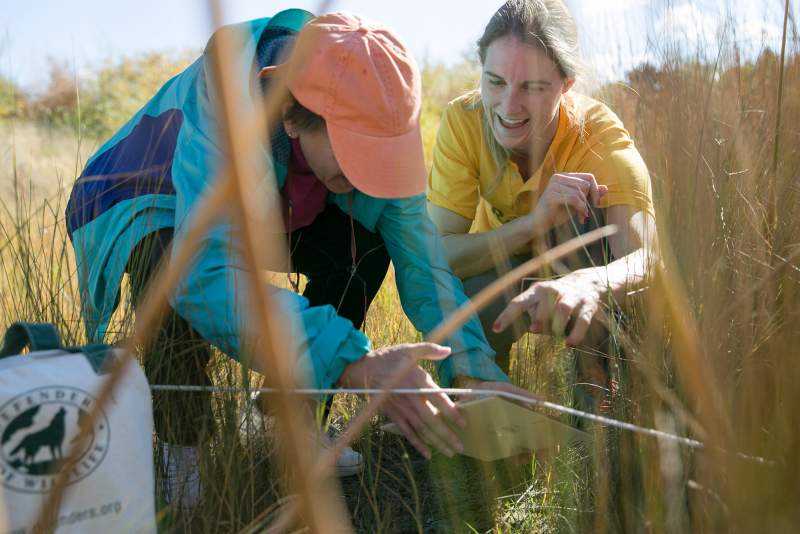
Coconis (right) with a NHMU volunteer, conducting biological surveys of a restored city park in Salt Lake City. Photo by Mark Johnston
Owen: Yet you persisted with the science part, too.
Ally: Yes, I was still very much fueled by the science. While working in education for NHMU, I also volunteered for their Vertebrate Zoology Department. I joined the biologists on many small mammal diversity surveys throughout the desert West, part of longitudinal studies—going back to the same place multiple times to see change over time. It gave me exposure to museum fieldwork including trapping to collect, preparing, and cataloging specimens. At the same time, I was doing night school for my master’s degree at the University of Utah, a professional master’s of science and technology, in environmental science with a focus on communication. For my degree, I did a project for the NHMU website, explaining the process of taking a specimen from the field to the drawer. I filmed trapping in the field, our curator preparing a specimen, talking about his specific research, all the steps along the way.
Owen: You seem to be really interested in lifting the curtain on science.
Ally: Absolutely. Like community science, which is such a great way to get people to care deeply about their community—to allow them to get down and dirty and collect data with you. I started NHMU’s community science program, using iNaturalist to document baseline and post-restoration diversity for Salt Lake City Parks & Recreation. We also got people to document the spread of the Eastern Fox Squirrel, which was introduced to Salt Lake City in 2011. Man, the public was on it! We could see how that species spread along the riparian corridor that follows the Jordan River. It was the only way we could have known how quickly they were spreading. At an even larger scale, we started a community of practice for community science in Utah, with the museum as a hub for museums, libraries, and other nonprofits interested in collaborating around community science.
Owen: How do you hope to contribute to our broader project of making more of our collection data accessible?
Ally: My goal in the next couple of years is to expand collections-based research. Not just people who are working in natural sciences, but also educators or artists, and perhaps even thinking outside the box to include medical science. When I was working on woodrats, our lab had some peripheral connections to the medical world that were interested in the mechanisms by which woodrats process harsh toxins.
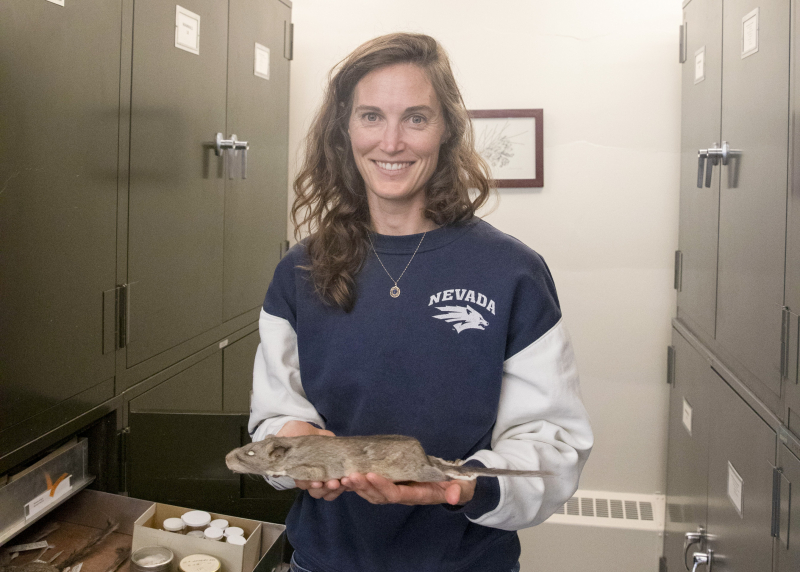
Coconis holding a Bushy-tailed Woodrat (Neotoma cinerea) in the collections at University of Nevada Reno Museum of Natural History, where she was a curatorial assistant during her Ph.D. Photo by Cynthia Scholl
Owen: Tell us more about woodrats and their superpowers!
Ally: Woodrats—gotta love ‘em. They are everywhere. There are a lot of species with different niches. They're great model systems to look at things like evolutionary processes and mechanisms that facilitate diversity. The heart of my Ph.D. thesis was looking at mechanisms of species distribution for two species of woodrats in the Great Basin Desert. For each species, I mapped out their predicted distribution based on abiotic factors such as climate, and then went into the field to ground-truth how their actual distributions mapped to these predicted distributions. Turns out the models were quite accurate.
A cool fact about woodrats is their role in preserving biological data. In the desert West, they will build their nests in the shelter of rocks, collecting a bunch of plant and animal material, like bones or other animal poop. Then they'll pee all over their nest, encasing these collections. That pee hardens and becomes kind of a protectant against the elements, which may preserve them for tens of thousands of years!
Owen: It's made a little museum.
Ally: They've made a museum. Absolutely. And when you excavate their nests, you find the things they collect. They love shiny things like cool rocks, bottlecaps, even dentures have been found in nests. Woodrats reuse these nests over generations, building up these piles and the collections they preserve. Researchers have dated some woodrat nests to 50,000 years before the present, so woodrats have been studied extensively in paleontology—and even archaeology because they collect traces of humans, too.
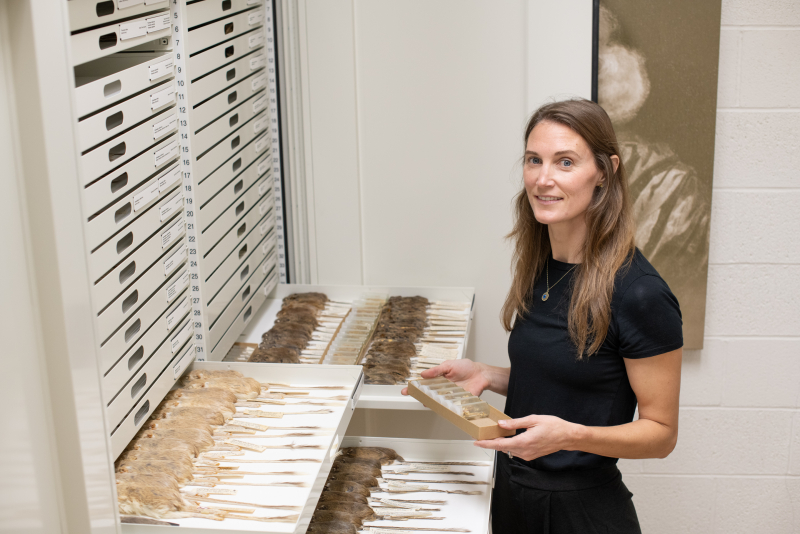
Coconis here at the Santa Barbara Museum of Natural History with kangaroo rats in the Vertebrate Zoology Collections
Owen: Sounds a little like Paul Collins’s work using the raptor nests of the Channel Islands as time capsules. How do you see this coastal region, mammalogically-speaking?
Ally: I think I'll be figuring that out for a while. I've been looking at a lot of range maps. There are a lot of similar genera to the desert West, where I focused my previous work, but the species and their niches are different. Marine mammals are a whole new world, and that's really exciting for me as well. But given my collaborators now, rodents across the West—particularly in central and southern California—will probably continue to be my bread and butter. There's a lot of really interesting things to study in terms of change over space and time with small mammals. They have fast reproduction and life cycles. That constant turnover makes it easier to see the effects of rapid climate and land use change, which are ever more apparent in this century.
Owen: What do you think we should be teaching people about mammals?
Ally: I’d like to help people understand the roles that mammals play in an ecosystem. Unfortunately, many mammals have historically been unjustly vilified: coyotes, gophers, woodrats… Gophers may frustrate gardeners and farmers; I absolutely get it. But they are incredible at aerating soil and are great food sources for mesocarnivores.* And ground-dwelling species that dig holes or build nests in particular provide shelter for lots of other organisms that coexist inside their nests or burrows. In fact, woodrat nests have been dubbed centers of biodiversity where microclimate conditions create great homes for many arthropods, lizards, other small mammals, and even snakes. Also, gophers and ground squirrels may help speed up post-fire recovery through soil aeration. This is something I am interested in exploring further—the relationship between small mammals and post-fire landscapes.
Owen: How do you see education and outreach intersecting with collections and research?
Ally: In a lot of ways. There are amazing educators here. Education is not my primary role anymore, but it’s absolutely the reason why I continue with museum science. I love working with students so much. They’re so fun and excitable. I've only been here a short time, but already Clay and Haylee have invited me to work with our teen interns on fun projects and collections work. I found a woodrat nest along the woodland trail, and we're going to put a wildlife camera on it! I had such great mentors and amazing opportunities in my undergraduate and graduate school. I would really like to pass along that torch by giving students opportunities to learn more about and get inspired by museum work.
Learn more about the Department of Vertebrate Zoology.
*Small-to-medium-sized carnivores
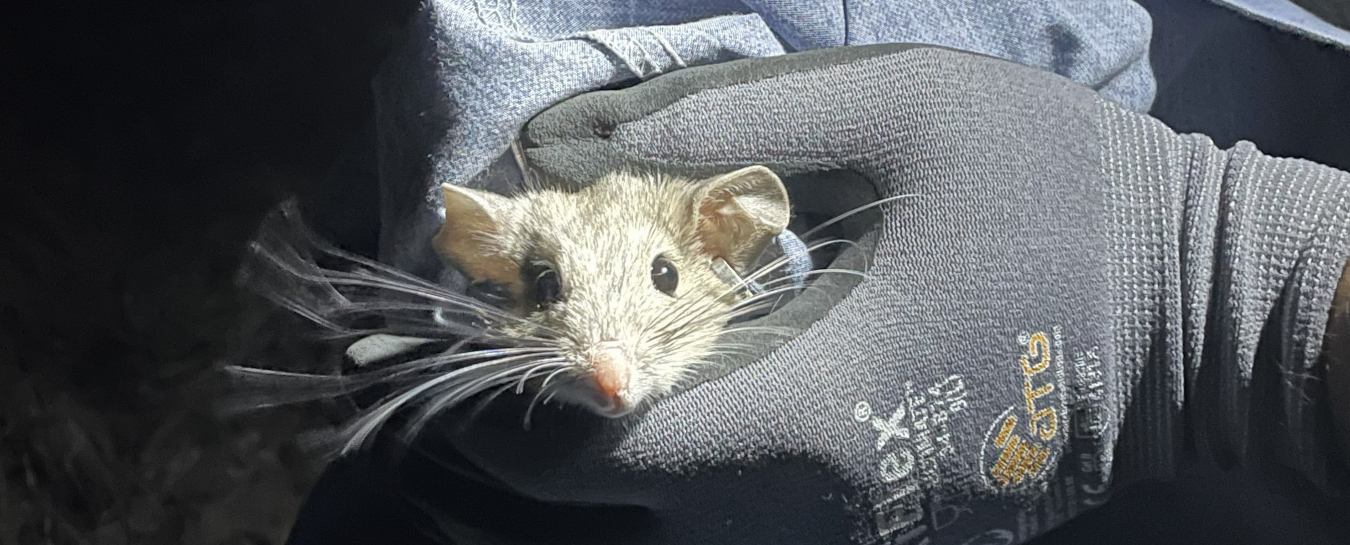
Top photo of a Desert Woodrat (Neotoma lepida) by Obedh Ornelas. Coconis captured the woodrat in Great Basin National Park in the summer of 2022 to collect genetic tissue and fecal matter for dietary and microbiome research.




0 Comments
Post a Comment