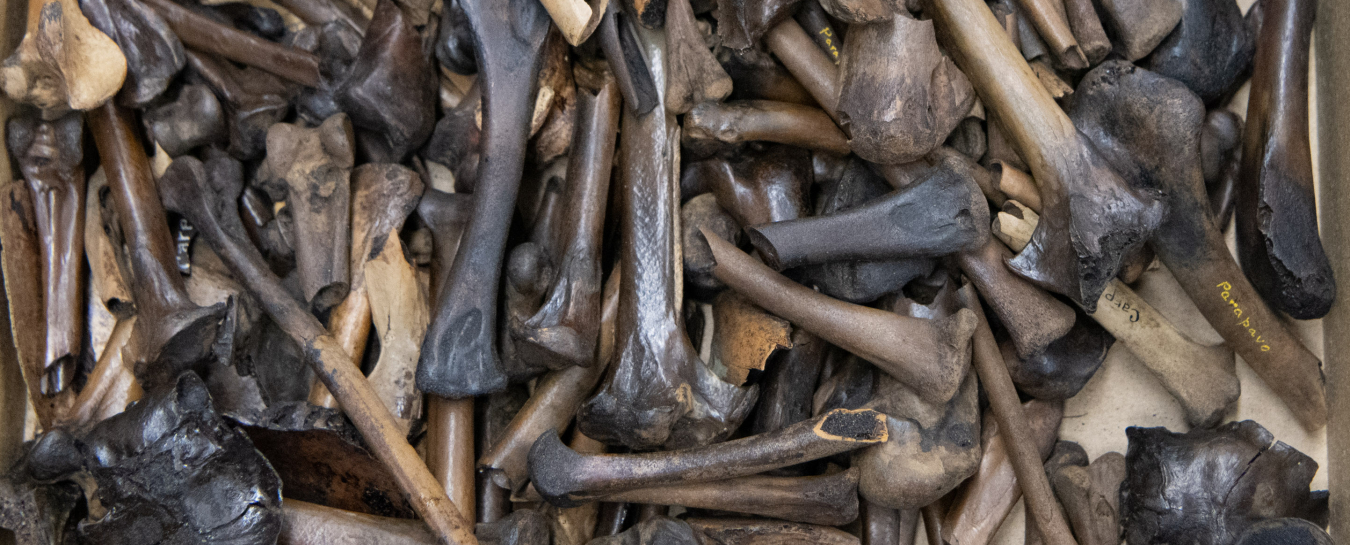
Tar Pits Bring Researchers Together
Something happened about 11–13,000 years ago that drove most large animals in the Americas extinct, dooming the mammoth, mastodon, and saber-toothed cat, among many others. The megafauna catastrophe seen in the Americas also unfolded in other parts of the world, apparently staggered by thousands of years. Scientists have proposed theories about the causes of this Late Pleistocene extinction event, assigning varied degrees of responsibility to climate change and human activity. Reaching scientific consensus around the solution to this whodunnit requires more data about who died when.
Researchers from La Brea Tar Pits & Museum recently visited Santa Barbara Museum of Natural History to examine a variety of megafauna (large animal) fossils from Carpinteria and the Channel Islands. SBMNH Dibblee Curator of Earth Science Jonathan Hoffman, Ph.D., helped a team of three La Brea scientists led by La Brea Tar Pits Associate Curator & Excavation Site Director Emily Lindsey, Ph.D. The collective goal of the visit is to contribute more data points to the Megafauna Extinction Dating and Isotope Project, which aims to date and analyze as many Late Pleistocene megafauna specimens as possible, with funding from Texas A&M University’s Center for the Study of the First Americans.
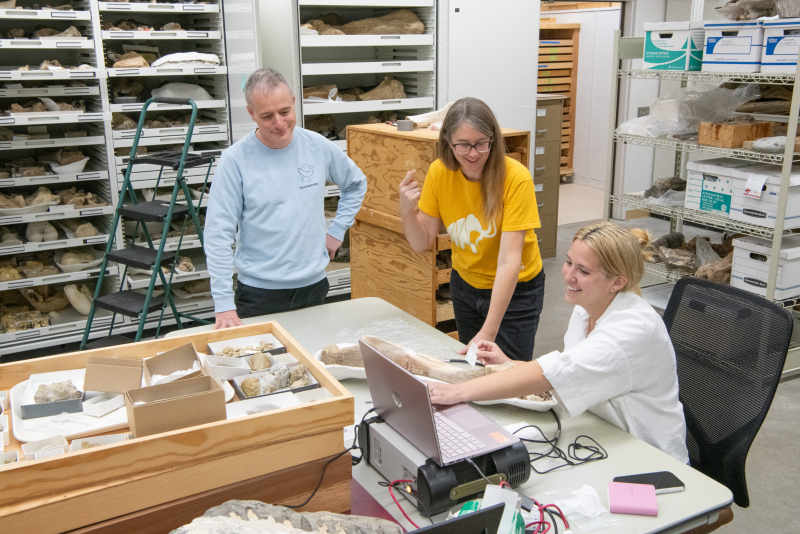
Greg Davies, Emily Lindsey, and Christina Ryder examine a Channel Islands Pygmy Mammoth humerus in SBMNH’s Earth Science Collection.
The visiting researchers used a cutting-edge piece of equipment: a device that helps determine which specimens are most likely to preserve the substances useful for radiocarbon dating and stable isotope analysis. Those analyses destroy a small amount of material, so researchers want every analysis of a precious fossil to count towards building our knowledge of the past—whether it’s anchoring the specimen in time or telling us more about the environment. Christina Ryder, Ph.D., a postdoctoral researcher from the Center for the Study of the First Americans, has helped develop this non-destructive pre-screening technique and published her findings to aid the fields of archaeology and paleontology.
The device is a spectrometer: it shines a beam of light on the specimen and measures what’s reflected back, detecting the signatures of useful substances such as collagen. Known as near-infrared spectroscopy, the use of unique wavelength signatures to identify components of matter is helpful to a wide range of scientists, from medical researchers monitoring blood oxygenation to astronomers studying the composition of distant objects.
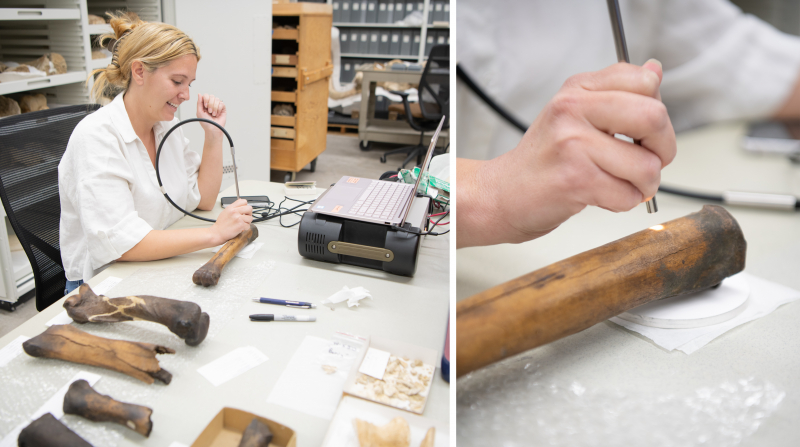
Ryder scans the metatarsal of a Pleistocene horse from Carpinteria’s Higgins Pit in search of collagen that could help yield a date.
Dr. Hoffman provided Dr. Ryder with access to specimens from the Carpinteria tar pits and Channel Islands to pre-screen them for potential radiocarbon dating and stable isotope analysis. The near-infrared spectra revealed that several Carpinteria fossils are remarkably well preserved, retaining collagen suitable for radiocarbon dating and stable isotope analysis. The researchers plan to have about a dozen specimens analyzed at the Keck Carbon Cycle Accelerator Mass Spectrometry facility at the University of California, Irvine.
What they learn from those analyses could significantly expand our understanding of Late Pleistocene extinction dynamics in the region. The wealth of specimens and radiocarbon data that has emerged from Rancho La Brea has given that location an outsized impact on our understanding of change over time in Pleistocene California. New data points from further up the coast at Carpinteria may reveal interesting comparisons that enrich our picture of the environments where the megafauna extinction unfolded.
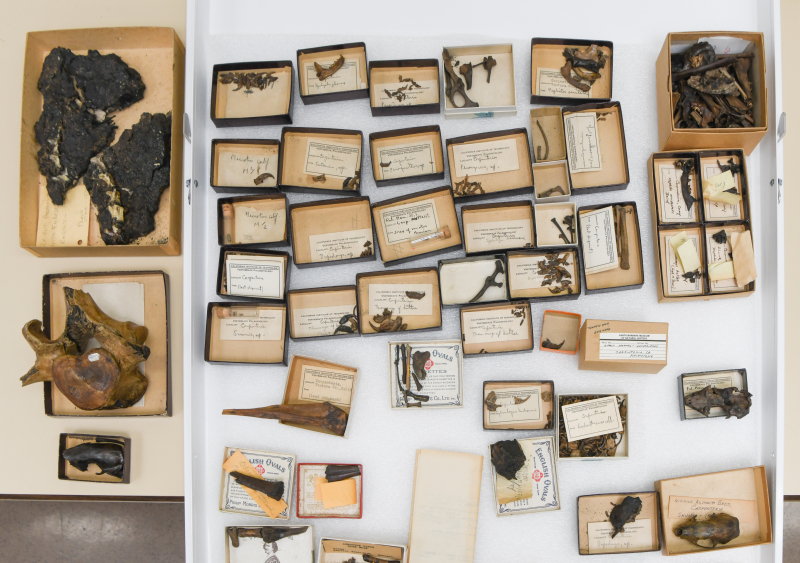
The Museum’s Carpinteria tar fossils—here’s a drawerful—range from megafauna like whales, mammoths, and camels to tiny snails and rodents. One of the unusual features of the Late Pleistocene extinction is that it left small animals relatively unscathed.
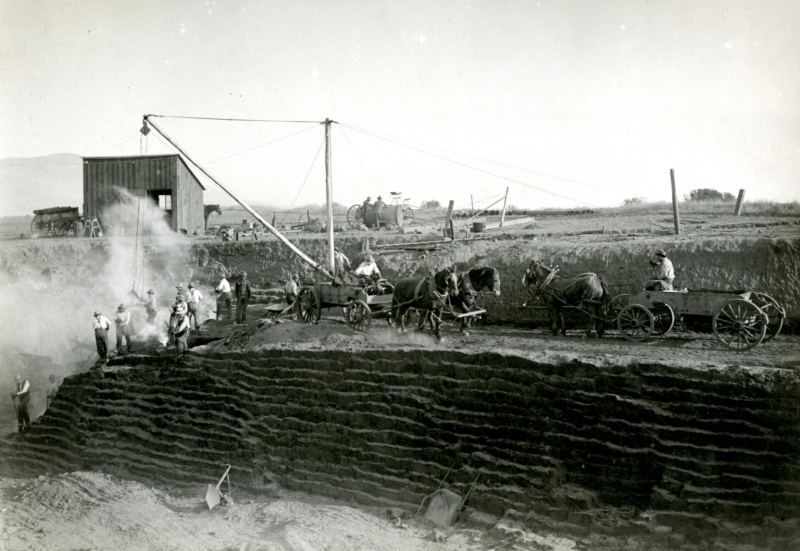
Many of the Museum’s tar fossil specimens were excavated back when Carpinteria’s tar was mined for commercial use. Asphaltum mine at Higgins Ranch in Carpinteria, circa 1910. Edson Smith Photo Collection no. 583, Santa Barbara Public Library
“This megafauna dating project and the use of this instrumentation is a boon to museums across the Americas,” says Hoffman, who is excited to have more data about the specimens in his care. “It will help us identify Pleistocene fossils with collagen, allowing us to pull out more details about the ecology of Pleistocene environments in the Western Hemisphere, including here in Santa Barbara.”
During the same visit, La Brea Tar Pits Assistant Collections Manager Greg B. Davies examined bird bones from the Carpinteria Tar Pits. He’s comparing bones found at Carpinteria and La Brea. California Condor bones are of particular interest because condors living on the coast probably had access to scavenged marine mammals, which may have protected them during a time of food scarcity on land.
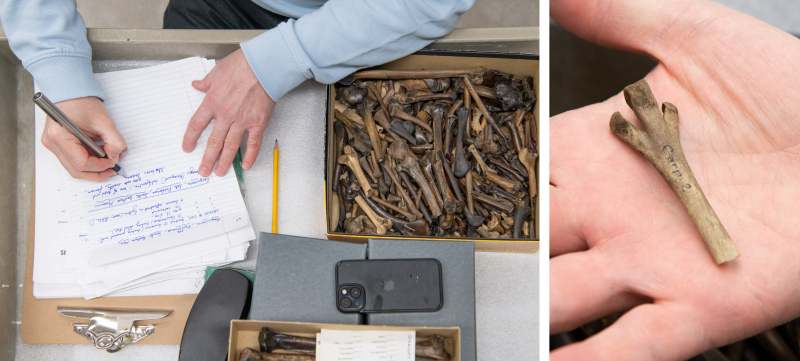
Davies examines bones of the extinct California Turkey, Meleagris californica, from Carpinteria’s Higgins Pit. Some bones have special clues for a biologist. The incompletely ossified foot bone at right would have belonged to a juvenile, indicating the birds were breeding in the area.
After this visit by La Brea researchers to SBMNH, SBMNH Fossil Preparator Ben Rotenberg, M.A., continued the collaboration during a weeklong stay at La Brea Tar Pits to learn from the leading global authorities on tar fossil preparation. Rotenberg’s week practicing specialized techniques in La Brea’s preparation lab was extremely productive. With assistance from La Brea staff and volunteers, he began to clear matrix away from several large SBMNH-held fossils from the Carpinteria tar pits. The specimen selection included bones from a whale, which may be the first whale found in a California tar pit. It’s likely that the animal was first buried by sandy deposits and only later subsumed into the tar as the coastline shifted.
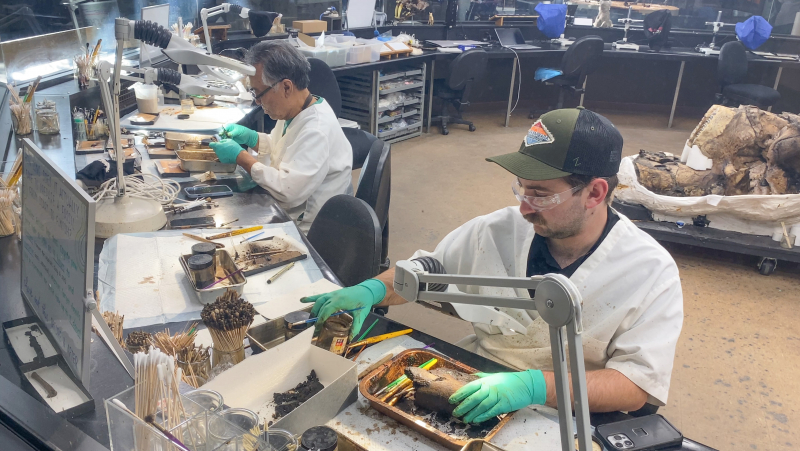
Rotenberg (right) uses solvents to prepare a tar fossil specimen from Carpinteria in the Fossil Lab at La Brea Tar Pits & Museum.
During Rotenberg’s visit, Rancho La Brea Fossil Lab Manager Stephany Potze and Preparator Connie Clarke shared insights from their research on solvents that remove matrix from tar fossils. Although La Brea has an industrial volume of millions of fossils to prepare, the work must be done cautiously by hand. While they aim to remove enough tar to reveal the specimen for study, Potze and Clarke often strategically leave some in place to help preserve fragile, ancient bones. La Brea staff have trained hundreds of volunteers in the highly specialized work of preparing tar fossils. They have also taught asphaltic fossil preparation to scientists, students, and museum technicians working at other tar pit localities around the world, including Trinidad and Peru. Sharing their techniques with Rotenberg adds one more person to the small but proud cadre of skilled preparators who make it possible for researchers to study the Pleistocene.
Learn more about paleontology at SBMNH on the Dibblee Geology Center’s page.
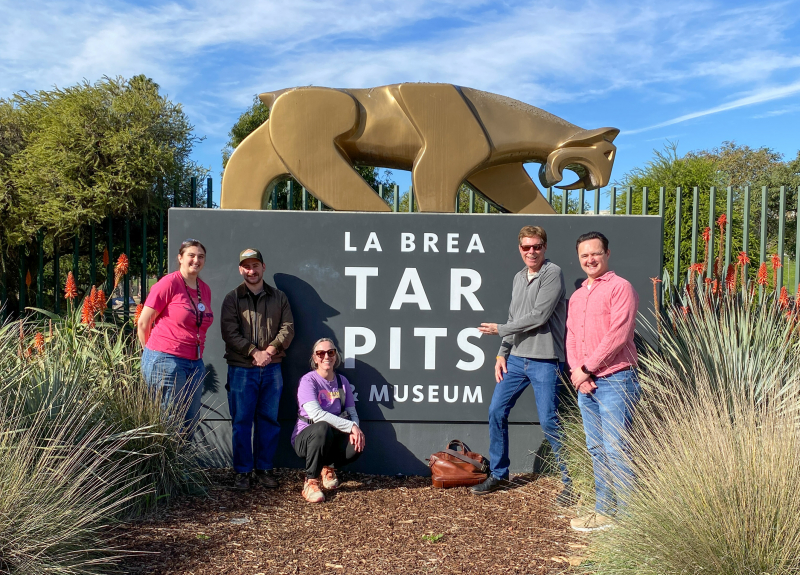
Left to right, Connie Clarke, Ben Rotenberg, Stephany Potze, SBMNH Volunteer Keith Reichel, Jonathan Hoffman




0 Comments
Post a Comment