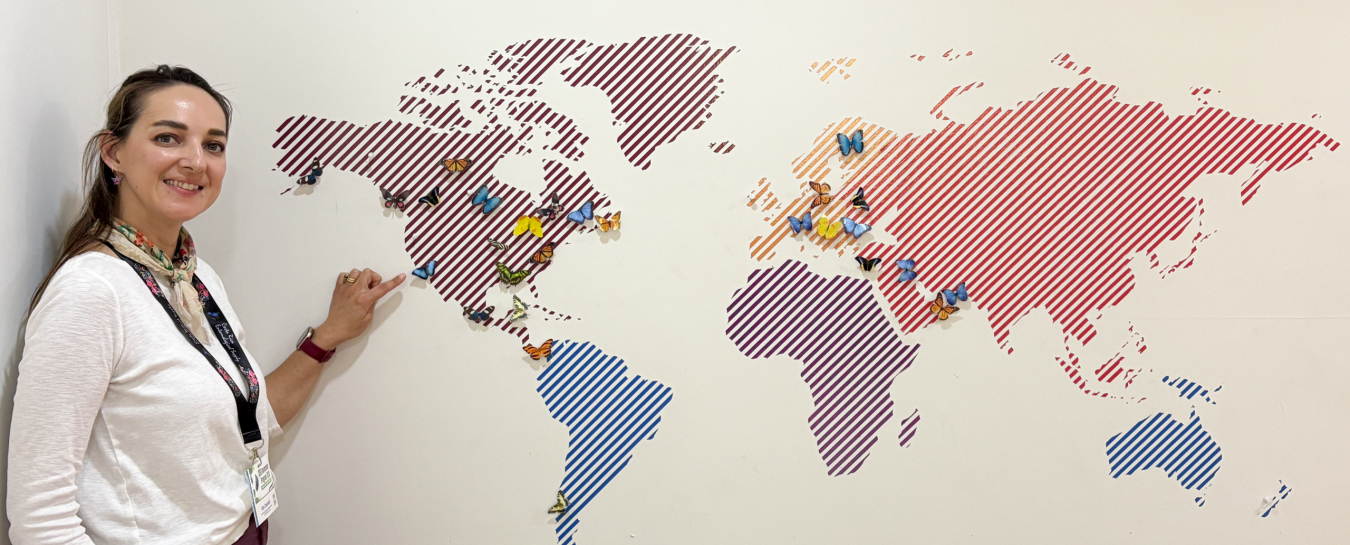
My Week with the Butterfly Farmers
This past February, I was invited to fly down to Costa Rica for a seven-day immersion program in butterfly farming. The goals of this immersion program were to gain a broader understanding of the role and impact of the butterfly industry in Costa Rica and to foster a deeper connection between butterfly farmers and exhibitors like the Museum. My personal goals as the Museum’s butterfly wrangler were to learn as much as I could about the business of butterfly farming, to meet the people behind the work, and to see a wild Blue Morpho. I was looking for a bit of adventure. My trip to Costa Rica was one of the most enriching experiences of my life. I gained so much respect for the hard work that goes into raising butterflies.
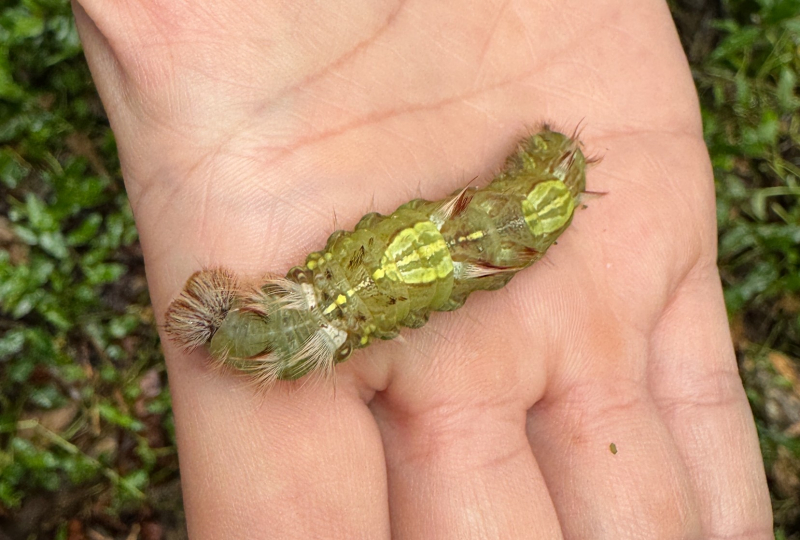
A Morpho caterpillar at Maroposario El Jabillo. Photos by Kim Zsembik
There are currently more than 150 butterfly farms throughout the small, conservation-minded country of Costa Rica, 90 of which work with Costa Rica Entomological Supply (CRES). CRES is the distributor that has supplied the Museum since 2022. Each farm varies in scale, in species, and commercial strategies. Farms are located from the Pacific to the Caribbean, and all the way to the cloud forests, with approximately 600 acres dedicated to butterfly farming.
Butterfly farming as an industry in Costa Rica began in the late 1980s and was initially pursued by women looking for work. Farming small-winged insects was caught up in gender politics and was considered "soft" and "unmanly" work for men to perform. The thinking was that women, who are encouraged from a young age to be nurturing, careful, and detailed, would be better suited for such delicate work. This allowed many women to generate income and give purpose and meaning to their lives outside of the normal gender roles of the household. As the export business of butterflies increased in the early 2000s, men started joining the enterprise and many farms today are family businesses, inherited generationally, and include extended families. This industry has allowed a single business to support whole family structures with stable and reliable work.
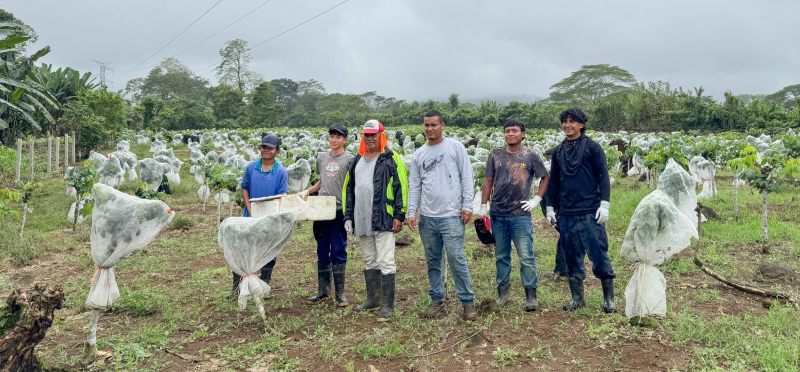
Butterfly farmers with host trees covered to protect caterpillars at Mariposario El Jabillo
This work isn’t easy by any means. What does it take to start exporting butterfly pupae to exhibits like ours? For starters, about a year of meeting compliance and regulatory standards including supervision by registered professional biologists, authorization by the Costa Rican Ministry of Environment, quarterly inspections, certification by the Ministry of Agriculture, permits from municipalities and the Ministry of Health, and of course tax filings under Costa Rica law. You also need land—on which to create structures for flying, egg laying, and pupation life cycles—plus supplies and labor. By now it’s probably clear to you that sustainable butterfly farming is not harvesting butterflies from the wild. Like the butterflies in our Butterflies Alive! exhibit, the butterflies bred on farms are restricted from being released into the wild, since regulators in Costa Rica are just as keen as the USDA on protecting habitat and agriculture from any butterfly-based disturbance.
My trip would give me an insider’s view of all this hard work. I visited two significant farms located on the Caribbean Lowlands, which due to climate are the most productive areas of butterfly farming in the country.
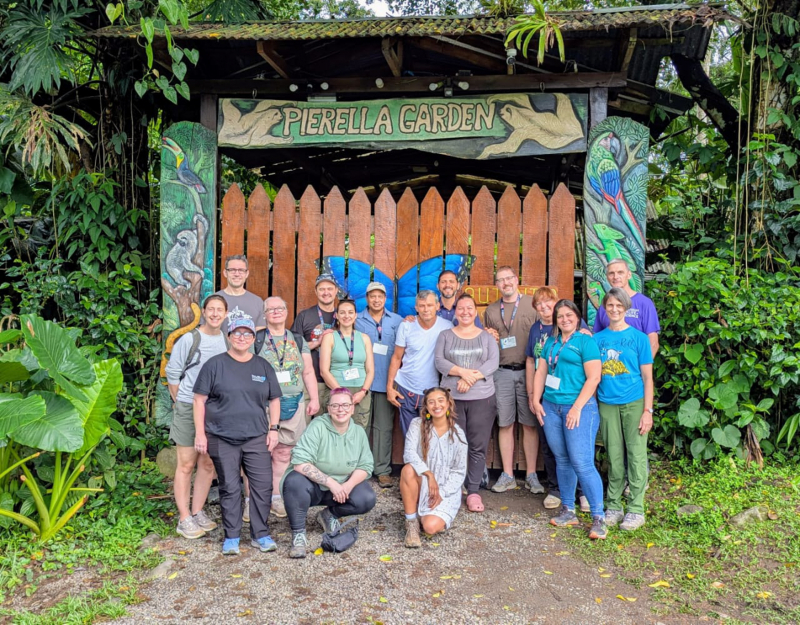
Our CRES tour group at Pierella Ecological Gardens with owner William Camacho, center
At Pierella Ecological Gardens, the farm’s owner William Camacho has a deep respect for nature, and a dedication to his land. To me, his work represents the heart of Costa Rica’s efforts to restore and conserve its land. William restored his land over the course of 30 years. He began with a single acre surrounded by cattle pasture, and today it’s nearly 20 acres of rainforest. He also expanded into ecotourism, hosting public tours of his land and farm, and providing lodging accommodations. Today, his land and gardens are organically managed and host sloths, bats, insects, reptiles, poison dart frogs and nearly a hundred bird species. This is all possible through regenerative practices like using healthy organic soils, embracing plant diversity, and minimizing the farm’s use of toxic products.
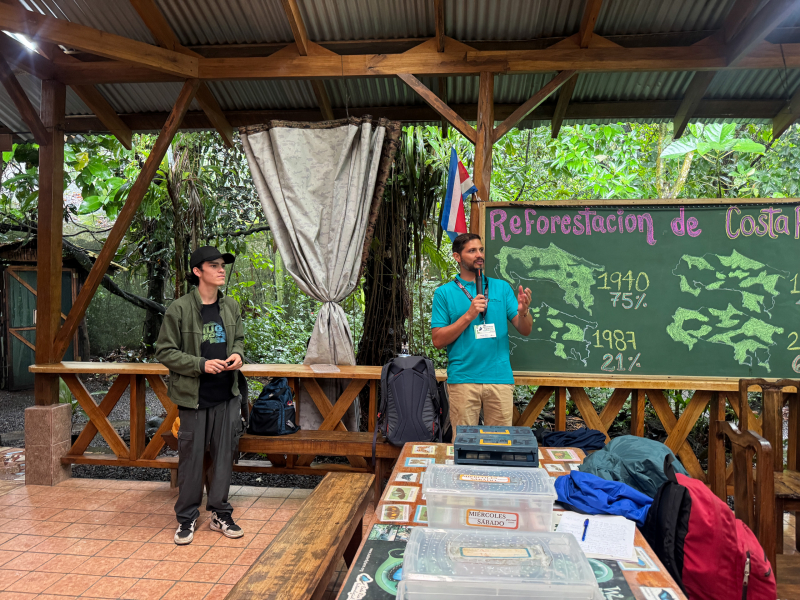
CRES Commercial Manager Sergio Siles talks about the history of Costa Rican reforestation at William’s farm in the Caribbean Lowlands. You can’t tell from this picture, but it’s pouring rain—that’s why he’s using a microphone to talk to just a dozen people. William’s son is at left.
William's farm produces 10,000 pupae per year. His strategy of farming relies on careful observations of each life cycle and allowing the available quantities of host plants to guide his quantities of pupae.
For many years I’ve been on the receiving end of chrysalis shipments coming to the Museum, but with William at Pierella, I learned more about the first part of the life cycle: eggs!
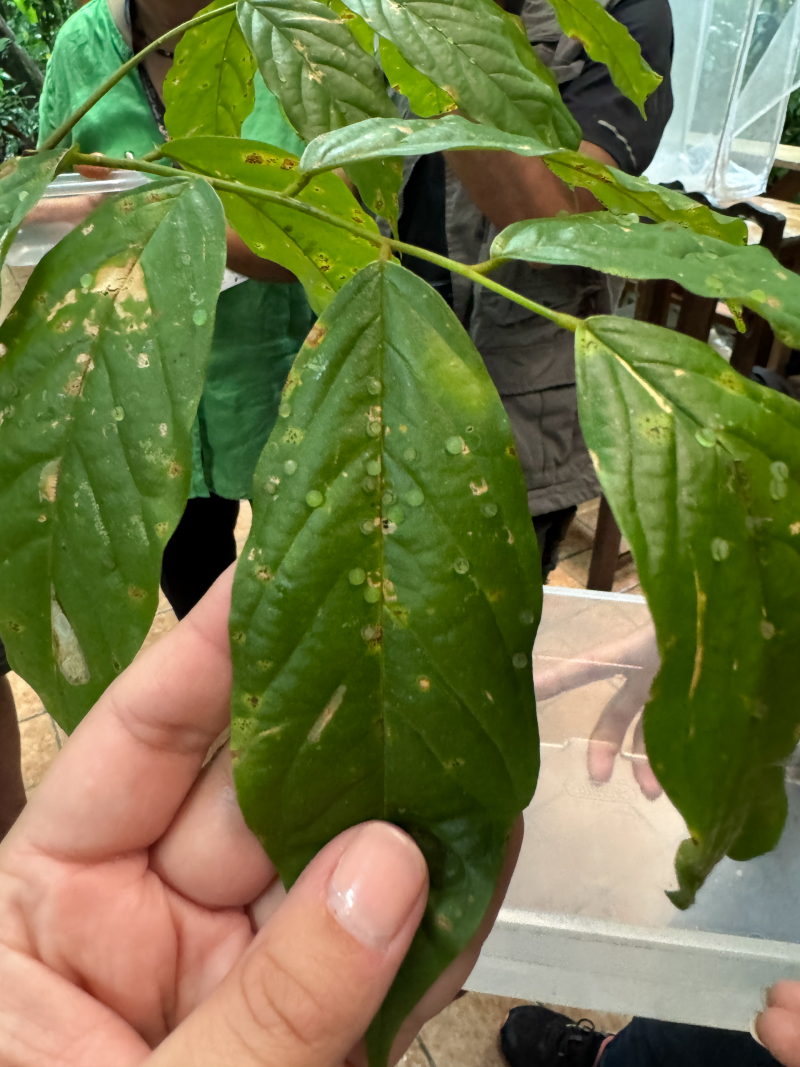
Preparing to hand-pull butterfly eggs from a host plant
William’s approach is to hand-pull each egg from the host plant leaf, then place them in a container labeled with the day of the week. I was able to participate in the initial egg sorting during my visit, and that singular task itself felt like it could take all day. It was my first hands-on experience in the butterfly farming process. While trying to carefully pick up a sticky button only the size of the head of a pin (about two millimeters), you must also identify if the egg may have been parasitized. Does it have a spotty crown around it? Healthy. Is it gray or cloudy? Unhealthy, parasitized. Eggs that appear parasitized or haven’t emerged after a week are removed to prevent the spread of organisms that would kill the butterflies. Each day, farmers sort butterflies at many stages of life, looking for signs of parasitism. In addition to sorting eggs, they also sort through the caterpillars in their first instar (caterpillars progress through five growth stages called instars before forming a chrysalis to undergo metamorphosis). At each instar stage, the caterpillars are moved to different areas of the farm. As hungry third and fourth instars, these caterpillars get dropped on large host plant trees. At William’s farm, those plants are of the legume/pea family. The farmers cover the plants with mesh bags to protect the caterpillars from predators. When finally in the fifth instar stage, these caterpillars are moved to enclosed boxes and baskets to pupate, as this stage of life is particularly susceptible to parasites laying their own eggs into the chrysalis.
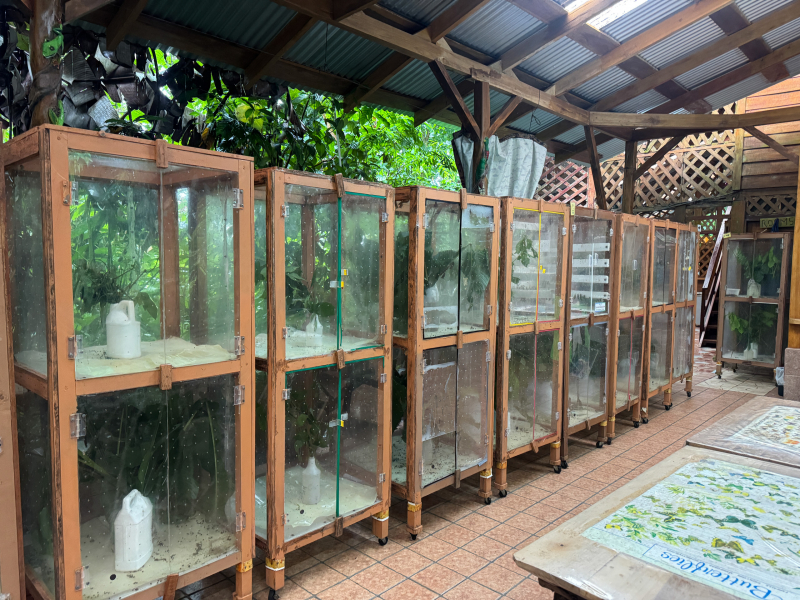
Cabinets at William’s farm separate groups of butterflies in different life stages. Repurposed jugs and bottles hold small batches of host plants in water.
Pierella Ecological Gardens exports with CRES weekly and supports innovation of butterfly farming by participating in pilot programs to train and mentor farmers in the area. William himself has transferred the daily butterfly raising duties onto an apprentice. For William and his wife Crystal, their personal focus is now on land conservation and ecotourism. Remaining business savvy, Pierella has diversified its revenue streams. William’s dedication to his land and restoring rainforest is his life’s mission.
The second farm I visited was Mariposario El Jabillo, a multi-site farm owned by Donald Arce. Donald and his family produce over 100,000 Blue Morpho (Morpho peleides) pupae per year, 65,000 of which CRES distributes around the world. Mariposario El Jabillo started in 2002 in the Caribbean lowlands where the soil is fertile and abundant rainfall supports rich agricultural productivity. El Jabillo is positioned in a competitive land area and currently neighbored by pineapple and yucca farming. Pesticide drift from these crops has killed some of Donald’s butterfly larvae. Handling these disruptions while balancing supply with demand for the epic Blue Morpho is an ongoing challenge.
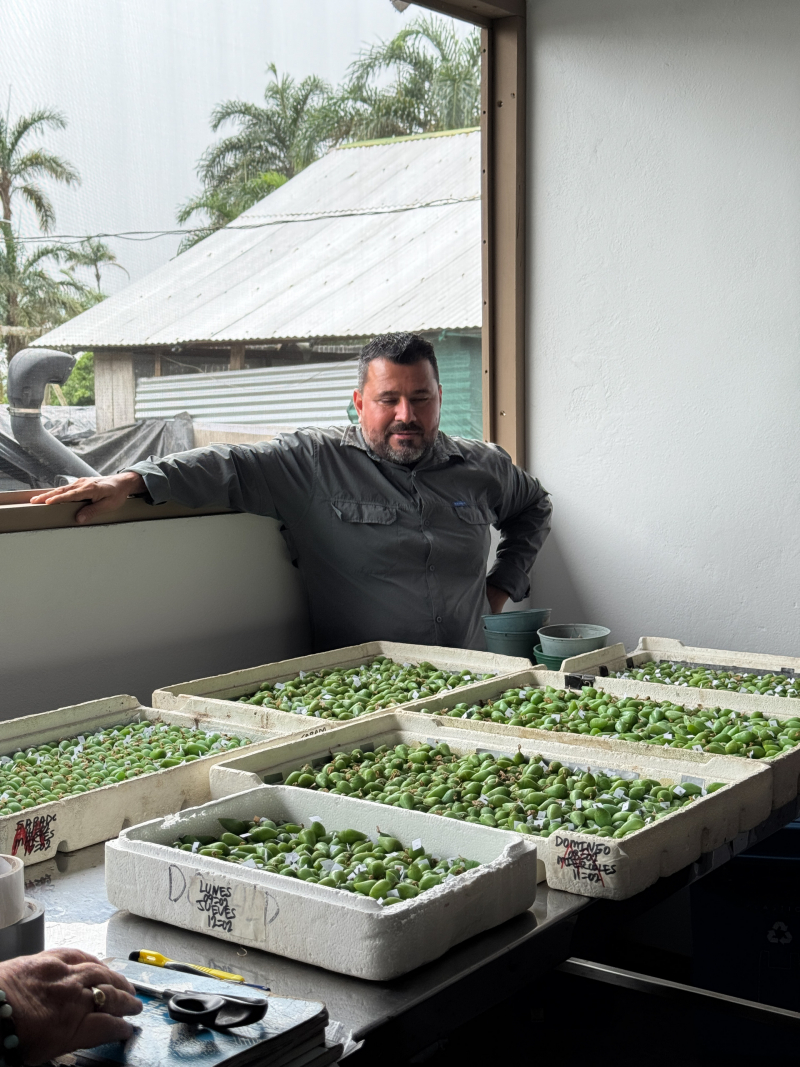
Donald surveys a harvest of fresh Morpho pupae with deserved pride.
Between 2002 and 2010, Donald struggled to rear enough pupae to make the business successful. He raised different species of butterflies including owls (Caligo sp.), swallowtails (Papilio sp.), and a few Morphos. In 2010, tragedy occurred and a viral outbreak in his rearing structures spread to every butterfly. Wiping out his entire farm, Donald was left with nothing. Trying new stock repeatedly, the virus kept reappearing and killing his butterflies. Unable to pinpoint how the virus remained on his farm, Donald decided to literally burn his infrastructure and start again from zero. The way he has bounced back from this devastation is amazing.
Over the next seven years, Donald slowly experimented with his process, innovating new techniques and protocols in his own backyard. After working with a professional biologist on his land plan, he was able to procure a healthy stock of Morpho eggs. In 2017, Donald became completely specialized in rearing Blue Morphos, standardized his operation, and began producing Morpho butterflies at a scale unmatched in the country.
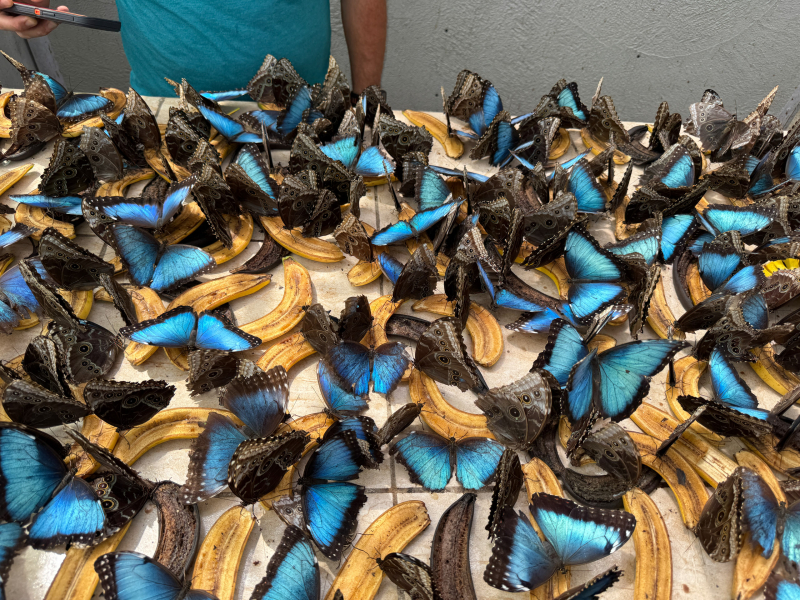
Adult Morphos feast on their favorite overripe bananas at El Jabillo.
When touring El Jabillo, I was struck and inspired by Donald's rigor for his work. He impressed me with his tenacity and ingenuity for finding a way through total loss. This is no longer a backyard operation; his farm is purposefully separated into three areas (about a 5–15-minute drive from each other) for each stage of the life cycle. This starts with egg-laying in his flying area. Donald keeps strict timing for egg-laying on host plants, removing the plants from the flying area before there is time for parasites to take hold. Moving to the larval stage, he uses hygienic supply practices—like sanitizing his larval plant covers between uses—because he can't risk total loss again. When we entered the flying area on our tour, we had to sanitize our shotes and hands. After what he and his butterflies have been through, I understand the rigor of these procedures.
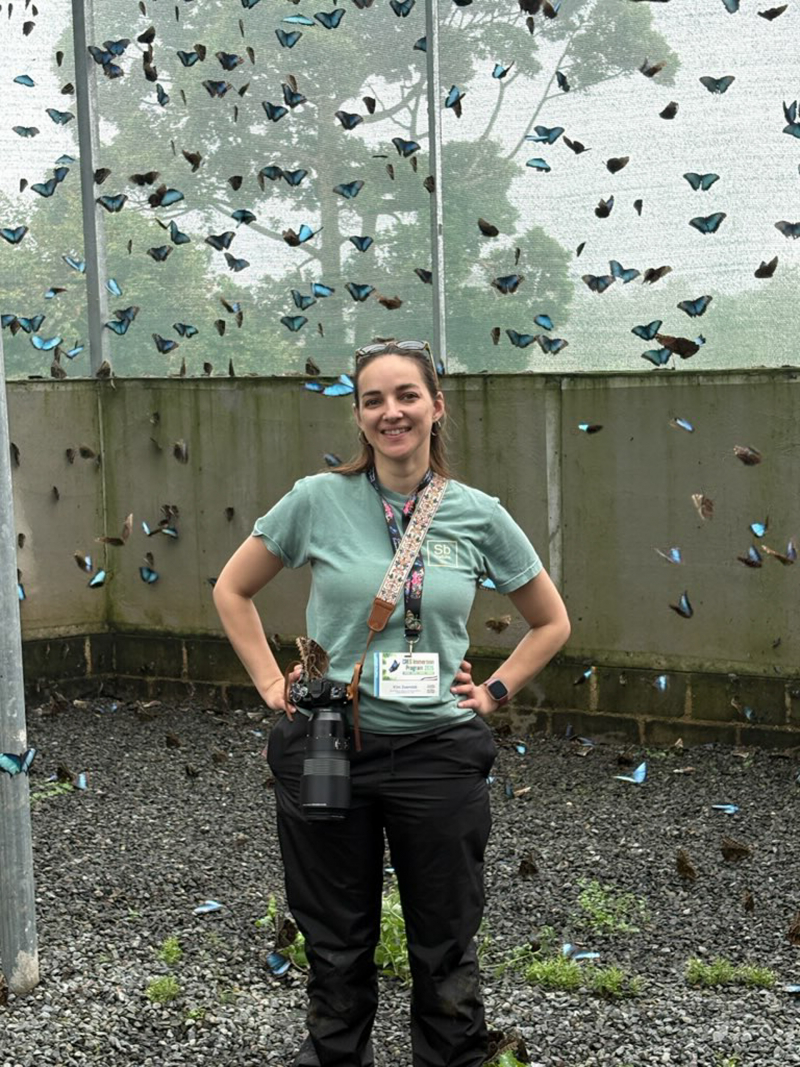
I had to sanitize to get in here, but it was worth it. Photo by Jonathan Hoffman
At the larval area—the next of the three sites of Mariposario El Jabillo—I had the opportunity to do some hands-on work. I started with prepping the plants that were about to be swarmed with 100 first instar caterpillars. I felt very accomplished when a worker assessed my plant and concluded that I had cleaned it of ants and spiders satisfactorily. No predators will harm my caterpillars! I applied my mesh cover to the plant and moved to tying off the bag with a strong, tight knot—"Duro! Duro!" says a worker. Admittedly, I need more practice with that step.
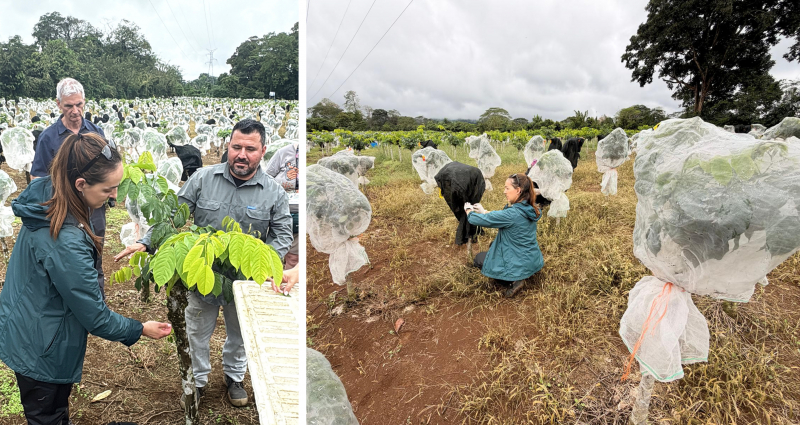
I learned from the farmers and tried my hand at wrapping up host plants to protect caterpillars.
Throughout the morning, the daily work entails prepping rows of new plants for caterpillars, clearing frass excreted by caterpillars busy eating and growing, and collecting and sorting fifth instar larvae that were nearing their pupation phase. It’s laborious work, usually done by a team of five at this farm.
At the third area of the farm, which is more of a laboratory, I took those fifth instar caterpillars and filtered the contenders for pupation one more time. Farmers don’t want to send out bad or infected stock; there is a selection process at play. I learned that Donald has an intuition for this. A caterpillar could be pulled because it "doesn't feel right" based on its squishiness or is rejected because its "color is wrong." It is a practice perfected through thousands of hours of experience. Finally, the most nerve-wracking task of all was pulling chrysalids ready for shipment from their pupation cage, an enclosed chamber where caterpillars are placed for their pupation phase. "Don't pull too hard," says Donald. This is a fine delicate task that he primarily saves for himself. I had to spray water to loosen the silk pad the caterpillar has left behind on the ceiling of the chamber, then carefully separate the fresh, soft pupa, ready for an exhibit like Butterflies Alive!
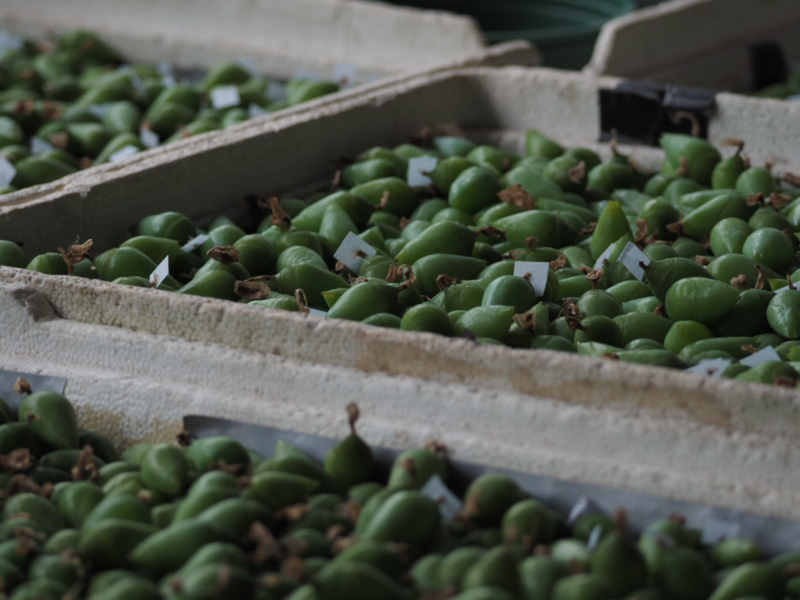
Morpho pupae at El Jabillo
This wouldn’t be the last time those pupae were scrutinized. CRES and exhibitors like the Museum monitor the pupae they receive. At the Museum, I keep track of how many successfully emerge as adult butterflies, and each month I submit a report back to CRES detailing which butterflies made it to the pavilion, noting any that appeared parasitized or were euthanized due to disease. The high quality control provided by CRES and the many farms with which they work keep the ratio healthy—far better than other suppliers I’ve used in the past.
All the program participants had a chance to spend time with Donald and his wife Karen, who welcomed us into their home for lunch. While sipping on coffee and nibbling on cake, I showed Donald photos from the Sprague Butterfly Pavilion, with one photo I took of a Morpho basking on a rock surrounded by guests and plants. "My butterfly," said Donald, hand on his heart. I couldn't help but be proud of the journey that this butterfly took and the part I play in the life cycle of international butterfly farming.
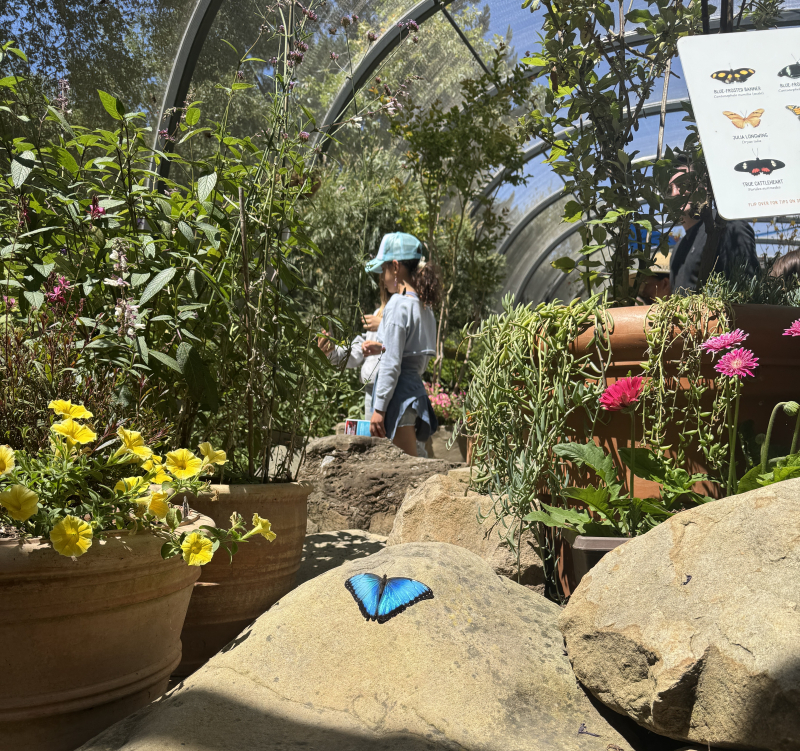
When I showed Donald this photo from our pavilion in 2025, he said “My butterfly.” Full circle!
It was life-altering to see the land, the care, and the science that brings the beautiful Blue Morpho to Santa Barbara. What started as a need for adventure ended with an even deeper appreciation and love for the work I do. I feel proud to play a small part in it all. I learned about the fragility of the cycle of farmer, distributor, and exhibitor. By supporting Butterflies Alive!, you are supporting a non-profit that supports CRES, who pays fair prices for butterfly stock from family farmers who earn income to support their communities. In nature, we're all part of a chain that connects us, and I'm excited to keep a "duro, duro" connection to butterflies, people, and the world.
Oh, and by the way, I did see a wild Morpho! Pura vida.
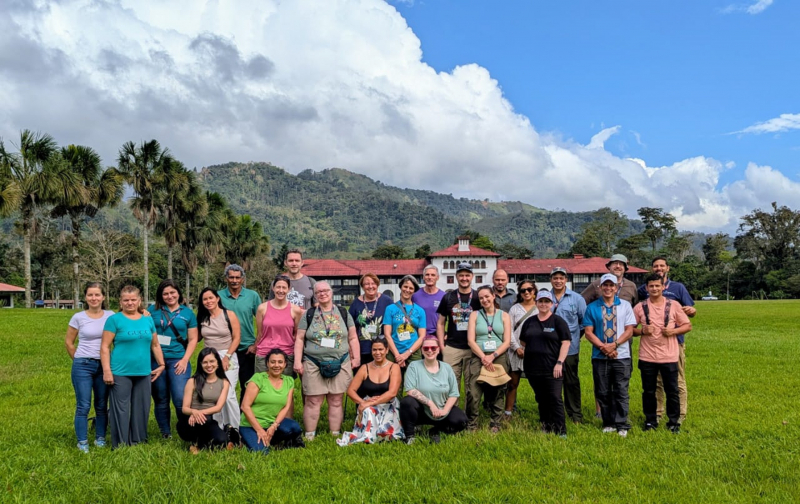
Farmers and exhibitors come together at CATIE Botanical Garden in Costa Rica.
About the Author
Director of Guest Experience Kim Zsembik has run Butterflies Alive! at Santa Barbara Museum of Natural History since 2018.




0 Comments
Post a Comment