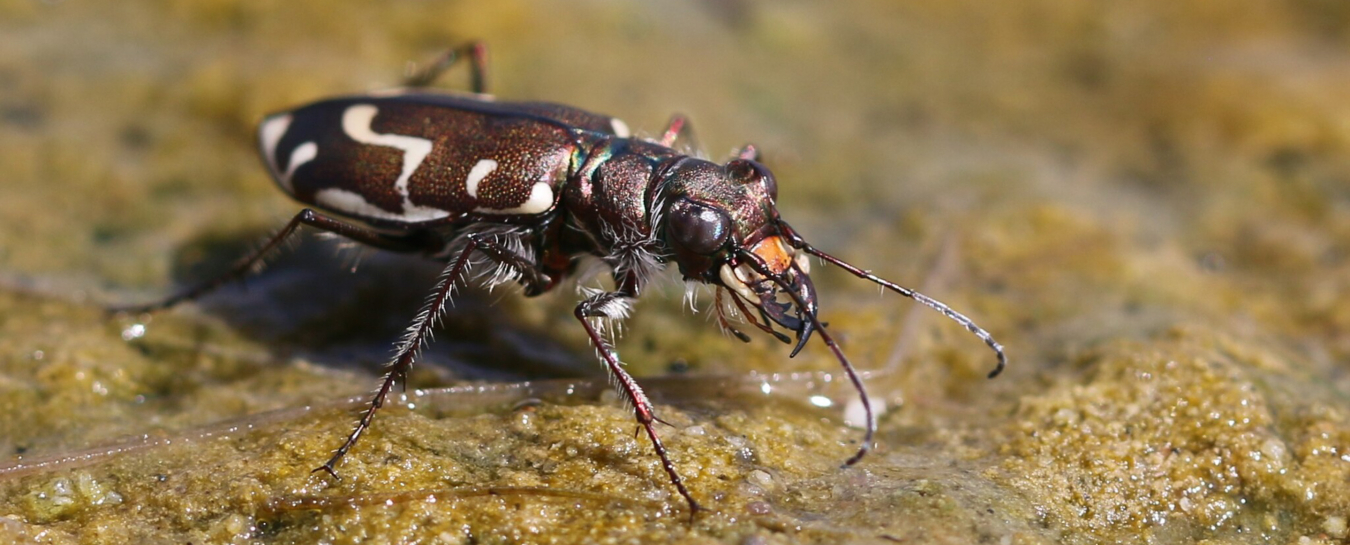
Illuminating the World’s Fastest Insects
Imagine yourself at the edge of a giant, barren-looking salt flat , extending for miles. At sunset, no animals are in view. As the gloom deepens, you switch on a portable blacklight at your side—a cheap gizmo designed for sale as dorm room decor. Before long, hundreds of insects have been attracted to your beacon in the dark. To understand how this simple party trick can be deployed in service of science, continue reading an interview with Schlinger Chair of Entomology, Alex Harman, Ph.D.
Owen Duncan: You just published an index to light attraction in North American tiger beetles, which could be really helpful for researchers whose work informs efforts to protect these insects. This paper is so much more than a literature review which could be done by somebody with no field experience. It makes use of your deep knowledge of North American tiger beetles—and the community science surrounding them. But for those of us who don’t know them yet, what’s a tiger beetle?
Alex Harman: Tiger beetles are some of the top insect predators. They’re actually a lot more like cheetahs than tigers. They hunt by running extremely fast across the ground, charging at prey with their mandibles open. I like to say that they run so fast they go blind. What actually happens is that they can’t process all the information their eyes are taking in, so if they don’t hit their prey, they stop, turn to see where it moved to, and charge again.
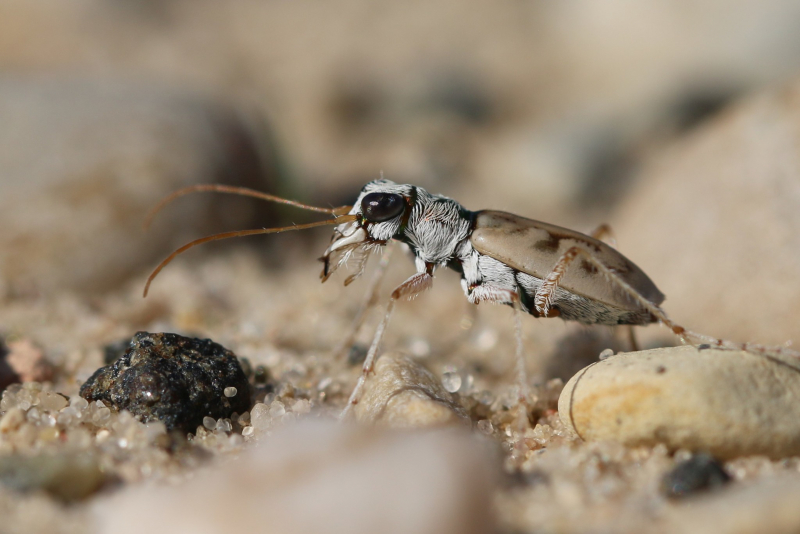
Ellipsoptera lepida, looking every millimeter the “cheetah beetle.” Photo by Alex Harman
AH continued: There are an estimated 2,700 described species, and many are rare species with small ranges. They need open ground without a lot of vegetation to hunt by charging around: places like sand dunes, mudflats, and sandbars. These habitats tend to be patchy and naturally ephemeral, so tiger beetle species are patchily distributed. On top of the natural factors fragmenting tiger beetle populations, we’ve heavily impacted the habitats of coastal species by disturbing and altering beaches and dunes.
Many tiger beetle species could theoretically be listed as endangered or protected at the state or the federal level. But in order to prove that something needs to be protected, you need to prove that it's declined.
OD: So you need population estimates. How has that been done, historically?
AH: There's multiple ways to count tiger beetles. You can go to a salt flat and count them, which is about as exact of a science as it sounds. You can walk transects.* But if you put me on a salt flat and you put someone who's maybe seen a tiger beetle or two in their life on a salt flat, we're going to get vastly different counts of abundance. You could do mark/recapture studies where, you know, you glue a little dot to them, or paint or clip their wing cases. But that's a lot of time and a lot of effort.
OD: This is where the light comes in?
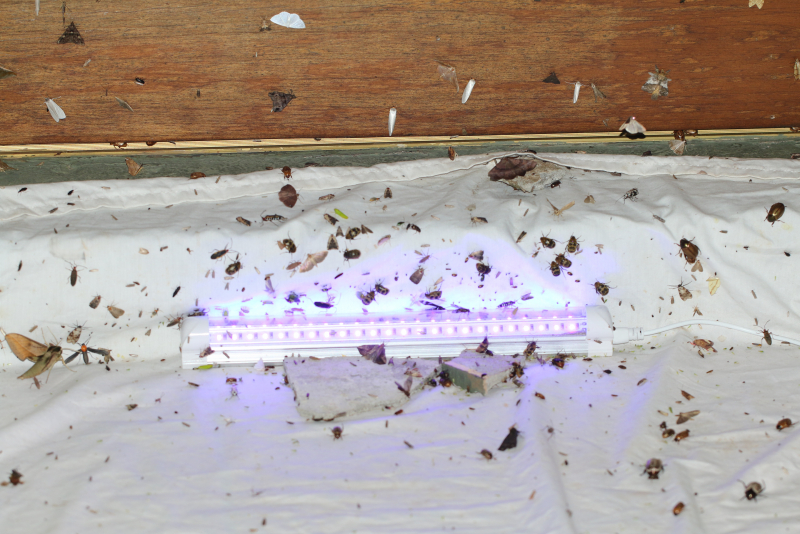
Insects attracted to a blacklight. Photo by Alex Harman
AH: Yes. Setting up a blacklight offers a cheap, easy, and standardizable way to survey tiger beetles. You don't have to worry about spotting them from 20 feet away before they fly off, because they're coming to you—as long as they’re part of a genus that’s commonly attracted to light.
OD: They aren't all the same in their attraction to light. That last part is what the table in your paper breaks down so beautifully. How did you do it?
AH: There are just two papers focusing on tiger beetles and light in the U.S. and Canada. These gave me a preliminary list of what species have been found at lights. But sometimes this means one person, somewhere, caught one at a light. Sometimes it’s anecdotal, and maybe a misidentification. But if you’re trying to estimate a population of tiger beetles and considering attracting them with light, you need to know if that technique is truly effective with that species. Not just did anyone, anywhere, ever find one at a light, but are they common at lights, in a way that could credibly inform a population estimate? That’s where other data sources came in, like photos on BugGuide.net and iNaturalist.
I've probably laid eyes on every tiger beetle photo submitted to iNaturalist in the United States. That's not an exaggeration. I have reviewed iNaturalist tiger beetle submissions pretty much daily since August 2017, and I’ve identified over 95,000 tiger beetle observations on iNaturalist.
OD: So you’re making use of your familiarity with those observations. Can tell by looking at the photo if it was attracted to light?
AH: You can generally tell if a photo was taken at night or not. If it's taken at night, with a white sheet as a background, there's a 99% chance that tiger beetle was attracted to a black light. By the way, the sheet is there to reflect the light and make it easier to observe the insects that are attracted.
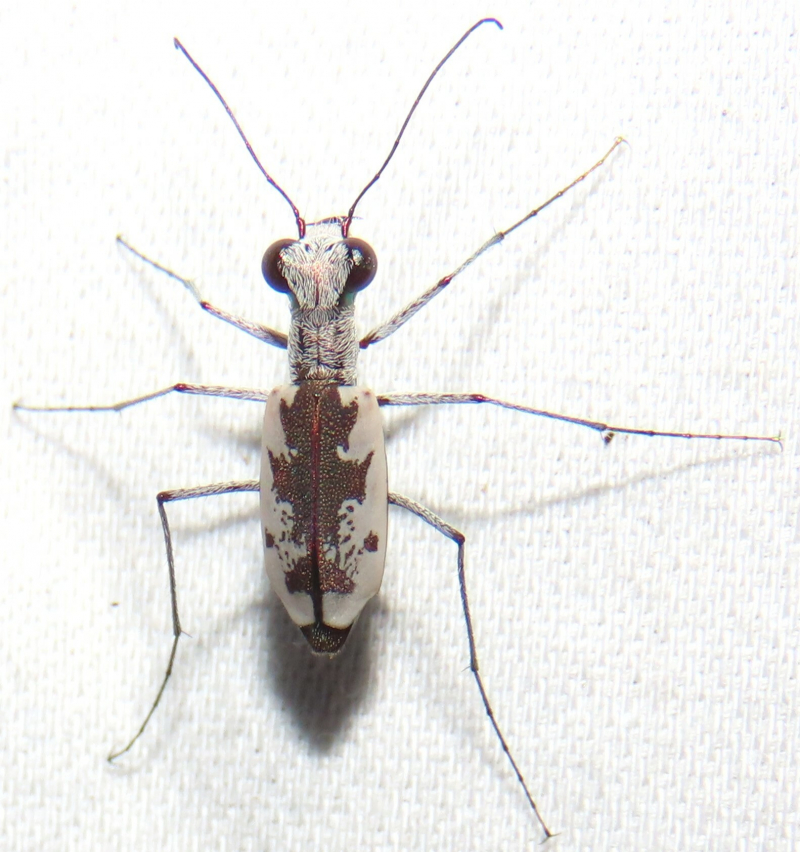
You don’t have to be an expert to see that this photo was probably taken on a sheet under a light. iNaturalist observation of Ellipsoptera hirtilabris by user kcthetc1
OD: You’ve done quite a bit of tiger beetle surveying yourself that informs this paper, too. Tell us about that.
AH: I've set up black lights in Wisconsin, Florida, Oklahoma, Texas, New Mexico, kind of throughout the southwest there, California quite a bit. Here’s an example of how blacklighting can make it much easier than chasing tiger beetles during the day. There's one particular subspecies of Ellipsoptera nevadica that's out on this mudflat in New Mexico. And I went out, I set some light traps. In the daytime, I saw just three individuals while I was out setting one light trap. I checked the trap the next day, and I had caught more than 47 individuals.
OD: What an effective tool! And now that your beautiful table tells us which species are common at lights, other researchers have the gift of knowing which species they can use it with to generate worthwhile data.
AH: Yes. The table covers the 125 species within 15 genera found in the United States and Canada. And looking at it we can see some patterns. Most of the genera that don't fly aren't commonly found at lights. The genus Cicindela flies, but isn't commonly found at lights—probably since their northern ranges and fall-to-spring lifecycle keeps them strictly active during the day. Most of the remaining genera are commonly found at lights, but check the paper for a detailed breakdown by species.
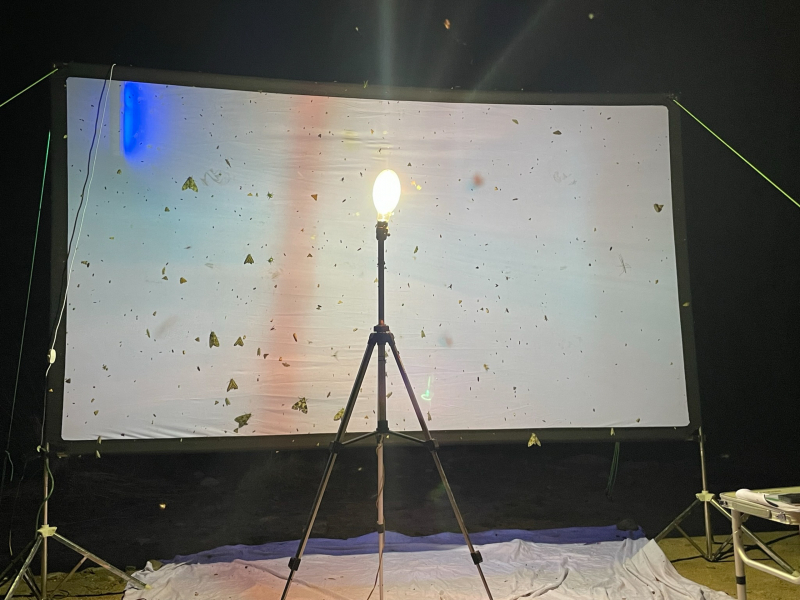
Like c-list celebrities crowding the red carpet, these insects seem to want their picture taken. Photo by Alex Harman
OD: How did people find nocturnal insects before the invention of electric light?
AH: A lot of the time, they didn’t. The largest beetle in the world, Titanus giganteus, is not that rare at lights in French Guiana. But back in 1771, it was rarely encountered. Linnaeus had to describe it on the basis of a single wing case someone brought him from the Amazon. A lot of species were considered incredibly rare for long periods of time, just because they were nocturnal.
OD: This attraction has—if you will—a dark side, too.
AH: Yes, it’s both really good and really bad! Light is a useful way to survey or collect insects for science. The flip side is when those insects fly to a gas station or a Dollar General—anecdotally, those have really bright lights—they’re vulnerable to predators. They can't burrow into the ground at dawn, because the ground is a parking lot or a sidewalk. House Sparrows, grackles, and other birds have learned they can find insects to eat at these places.
Because this light pollution happens every night on a massive scale, it doesn't just affect those individual insects that get eaten, but the wider populations they belong to. It disrupts mating. It disrupts egg laying. Anything that nocturnal insects are supposed to do, they're not doing if they're sitting next to a street light or gas station light or something like that.

Where dim bugs go to die and bright birds go for breakfast. Photo by Mark Buckawicki
OD: It's like young people being on social media instead of, you know, out meeting each other in the real world.
AH: Yes. The insects at the lights are the iPad kids! It's distracting them from what they'd naturally do to perpetuate the species.
OD: Does this negative side effect inform how you would deploy blacklighting as a scientific tool?
AH: It's definitely a different magnitude. City lights, gas stations, dollar stores—these lights are on all night, every night. Blacklighting is typically done only a couple nights at a time. If you do it in the same place more than three nights in a row, other animals learn what's going on pretty quick, and that will mess up your results. I had some issues with the skunks when I was in grad school. Skunks love your big giant Cecropia Moth, Luna Moth, Imperial Moth, those sorts of things. It's jarring to wake up at 4:00 AM to check your blacklighting sheet, and there's nothing but little piles of wings where each moth used to be. In addition to not lighting up the same space night after night, it's best to turn off the light before daytime to allow insects to disperse.
And then there's actually a difference here that I haven't mentioned yet: there's light trapping—over a pan of soapy water or a funnel trap—and there's plain old blacklighting and seeing what shows up.
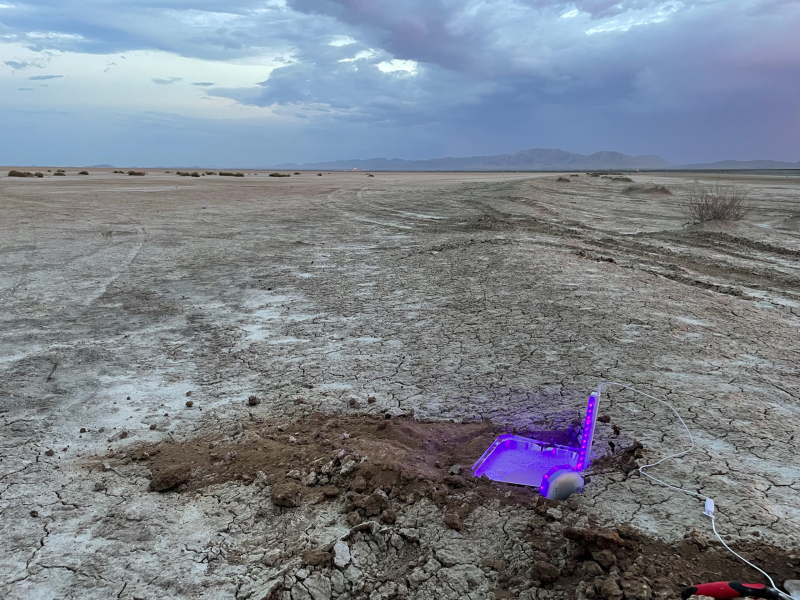
The setup for a killer party. Photo by Alex Harman
AH continued: Nowadays there are far fewer collectors than there used to be, and most people getting into insects are content to watch and photograph. It's valuable to have specimens in museums for DNA and reference purposes. At the same time, responsible entomologists are careful not to do too much lethal sampling on these rare populations, since the whole point is to understand and protect.
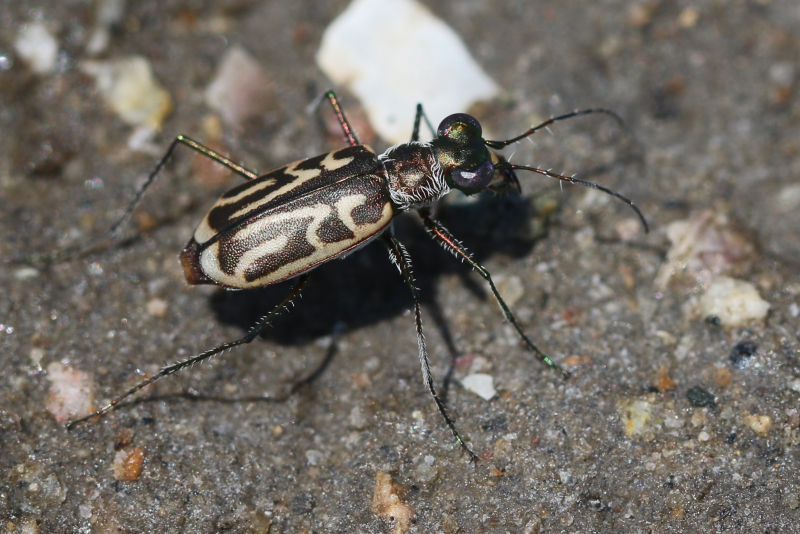
Eunota gabbii is a rare species with only three extant populations in the U.S., all in southern California. It is strongly attracted to light, which may cause declines in the species despite most of its remaining habitat being protected. Photo by Alex Harman
*A transect is a line of a set length—the position of which may be fixed or randomized—followed by biologists to standardize data collection across multiple surveys.
Harman, Alexander. (2026). Tiger Beetle (Coleoptera: Cicindelidae) Attraction to Lights, an Underutilized Method for Population Monitoring and an Overlooked Threat. The Coleopterists Bulletin. 80. 302-308.
Top photo: Cicindella hirticollis along a freshwater lagoon on Ormond Beach in Oxnard. Photo by Alex Harman





1 Comment
Post a CommentIt was a good observation by much appreciated, I did my doctoral degree on tiger beetles of southern India, I collected most of the diurnal species of tiger beetles from most part of India, few of the species were nocturnal, and many of the diurnal tiger beetles were also observed by me near any light sources, as these light attracts lot of other insects, I observed that tiger beetles were after these insects as well. I saw many of them predating on the insects crawling under light poles on soil substrate. Your work to use for census of tiger beetles for long time record at one sight is very useful. In my studies along a respects of 100 meters C. aurofasciata, C. Calligrama, C. biclor were abundant during 1985 - 1989 and in the same transect during 2023 no tiger beetles of these species were recorded.