Dark Matter Under the Gravitational Lens
At the Museum | Farrand Auditorium
Dark matter is a cornerstone of modern cosmology, successfully explaining the large-scale structure of the universe—from the cosmic microwave background to the rotation curves of galaxies. While its existence is well established, the fundamental nature of dark matter remains unknown, with many competing theoretical models that make similar predictions on large scales but differ in their behavior on smaller ones.
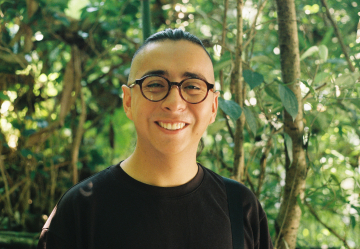
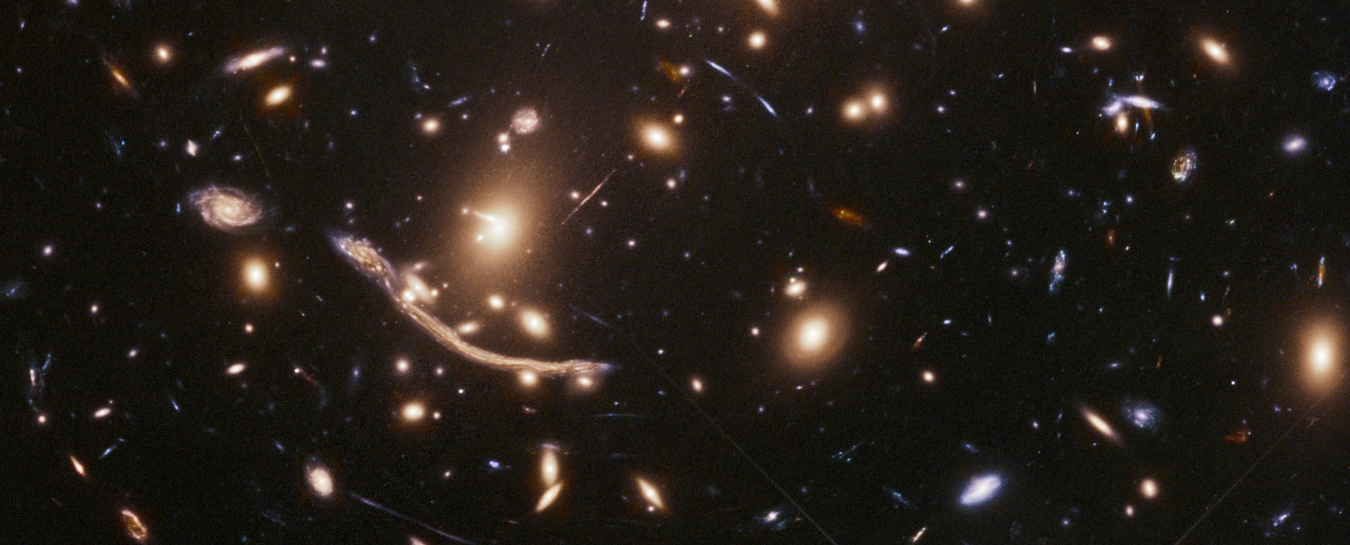
In this talk, UCSB Physics graduate student Joaquin Becerra Espinoza will trace the role of dark matter through cosmic history, focusing on galaxy clusters as powerful laboratories for testing these competing models. He will show how gravitational lensing—the bending of light by massive objects—provides a unique, purely gravitational way to study dark matter. He will conclude by highlighting caustic-crossing events, in which stars or other compact sources are briefly and dramatically magnified, offering an exceptionally sensitive probe of the small-scale structure of dark matter and possible departures from the standard picture.
Joaquin Becerra Espinoza studies cosmology under the supervision of Tejaswi Nerella. His research focuses on gravitational lensing—of both light and gravitational waves—as a tool to study dark matter. Recently, his work has centered on caustic-crossing events in giant arcs. He is also a former writer for the blog Astrobitos.
No tickets or reservations required.
This event is part of a monthly series of free astronomy talks presented by Santa Barbara’s astronomy club, the Santa Barbara Astronomical Unit (SBAU). Look for more talks and free Star Parties with the SBAU on the Museum’s astronomy calendar.
Questions? Contact Astronomy Programs Manager Ila Jade Komasa at ijadekomasa@sbnature2.org or 805-682-4711 ext. 164.
Top image shows galaxy cluster Abell 370. In it there is a strongly lensed galaxy, the Dragon Arc, whose light has come a long way—its redshift is estimated to be z = 0.725, i.e. the universe was (roughly) half its age! Image by NASA, ESA, A. Koekemoer, M. Jauzac, C. Steinhardt, and the BUFFALO team
Find more events like this