Field Trips at the Sea Center
Fall 2026 Registration
- Opens Wednesday, August 26, 2026 at 3:00 PM
(For visits Sep. 23–Dec.18, 2026)
Winter 2027 Registration
- Opens Wednesday, November 4, 2026 at 3:00 PM
(For visits January 6–March 26, 2027)
Spring 2027 Registration
- Opens Wednesday, January 13, 2027 at 3:00 PM
(For visits April 5–May 21, 2027)
Registration
We are delighted to offer a variety of NGSS-aligned guided school field trip programs and guided exhibit tours for the 2026-27 school year, designed for grades K-12.
If you are interested in a self-guided visit, please submit a request for a reservation at least 1-2 weeks in advance using our online Group Visit Request form for self-guided tours at the Sea Center. If you have questions please email seacenterbookings@sbnature2.org.
Program Options
2-Hour Program
- This program includes a 1-hour NGSS-aligned lesson held outdoors (either on our patio or at the beach), followed by a seaside snack and a 1-hour guided exhibit tour inside the Sea Center.
- We can accommodate two classes of the same grade level from the same school within this 2-hour time block. One class will begin with the outdoor lesson while the other starts with their guided tour inside the Sea Center. After the snack break, the groups will switch.
- This program is available on Tuesdays and Wednesdays (September–December).
- You may review our lesson menu and select a preferred lesson during booking. While we do our best to accommodate preferences, we cannot guarantee them. If no preference is provided—or if scheduling, staffing, or weather constraints require flexibility—we will select a lesson based on your grade level, staffing availability, and current conditions.
1-Hour Program
- This program includes a 1-hour guided exhibit tour inside the Sea Center.
- Please note: If you arrive late, your program will still end at the originally scheduled time.
- If two classes from the same school book both time slots, one class may attend the tour from 10:00–11:00 AM and the other from 11:00 AM–12:00 PM. We are unable to supervise classes outside of their scheduled tour time. We recommend that the class not in session spend time at the beach or park for lunch while the other class participates in the tour.
- This program is available on Thursdays and Fridays (September–December).
Have more questions about your options?
Check our Sea Center Field Trip FAQ or contact seacenterbookings@sbnature2.org.
Menu of Programs
The field trips below are grouped by their alignment with grade-specific Next Generation Science Standards (NGSS) and Ocean Literacy Principles (OLP). They can all be adjusted to work for a range of grade levels.
Learn more about NGSS here.
Learn more about OLP here.
If you’re interested in a program listed for another grade, please contact seacenterbookings@sbnature2.org for details or to have a program adjusted for your class.
Jump to programs by grade-specific standards
Kindergarten Lessons
Patio Lesson- Trip to The Tide Pools
NGSS: K-LS1-1, K-ESS3-1
OLP: Principle 5B, Principle 5A.4
Key Topics: Intertidal zones, adaptions, resources, habitats
Students learn what the basic needs of marine animals are, and what unique and resilient marine animals can commonly be found in our own local Intertidal zone, or tide pools. They make observations about how these intertidal animals meet their needs in this ever-changing habitat. This activity includes an interactive matching game for students to showcase which animals they think belong to each intertidal zone.
Beach Lesson - Beach Wrack: The Secret Ecosystem at Your Feet
NGSS: K-ESS3-3, K-LS1-1
OLP: Principle 6
Key Topics: Beach wrack, food chains, ecosystems, habitats
Why is beach grooming harmful to local ecosystems? Students will use data they collect on the beach to understand the importance of beach wrack. They will dive into food chains to see how shorebirds and other local species are negatively impacted by the removal of organic and inorganic material from the beach. The activity for this lesson includes data collection and group discussion sessions on the beach.
Patio Lesson – Beach Wrack: The Secret Ecosystem at Your Feet
NGSS: K-ESS3-3, K-LS1-1
OLP: Principle 6
Key Topics: Beach wrack, food chains, ecosystems, habitats
Students will explore the impacts of beach grooming by acting as shorebirds hunting for food on groomed and ungroomed beaches. After observing the differences in resource availability, they will be able to explain the impacts removing beach wrack has on the local food chain. The activity for this lesson includes using interactive beach models to better understand food chains and ecosystem dynamics.
Patio Lesson – Biomimicry
NGSS: K-LS1-1
OLP: Principle 5A.4
Key Topics: Biomimicry, ocean adaptation, external structures, survival traits
Students explore the concept of biomimicry by learning how plants and animals use external body parts and structures to survive. After discussing examples from nature, students select a mystery object from a bin and imagine how it could function as a survival adaptation. The activity for this lesson includes students using objects and “dress up” to better understand adaptations and camouflage.
1st Grade Lessons
Patio Lesson- Powerful and Precious Pups of Shark Cove
NGSS: 1-LS1-2
OLP: Principle 5, Principle 6
Key Topics: Sharks, parental care, eggs, embryos, offspring survival
Students get to see up close how local swell shark and horn shark embryos are able to survive throughout the long months spent unhatched in their beautiful, strong egg cases. Students handle, observe, discover, and share the differences between real egg case specimens then learn about the effective parental behaviors exhibited by each species. The activity for this lesson includes students using interactive reef models to determine the best place for a mother shark to hide their eggs.
Patio Lesson- Camouflage, Biodiversity and Protecting Young
NGSS: 1-LS1-2, 1-LS3-1, 2-LS4-1
OLP: Principle 5. Principle 6
Key Topics: Camouflage, baby animals, prenatal care, habitats, biodiversity
Students learn how to identify different habitats that we have here off the California coast and what different adaptations may be advantageous to have as both an adult and baby animal in these habitats. Students will focus specifically on the idea of camouflage and why this can be a unique and useful tool that can sometimes look different for babies and adult animals. The activity for this lesson involves kids drawing “camouflage” eye masks with colored pencils that blend in with a local habitat.
Patio or Beach Lesson- WMAFAF (What Makes A Fish A Fish?)
NGSS: 1-LS3-1, K-2-ETS1-1
OLP: Principle 5A, Principle 5A4
Key Topics: Structure and function, diversity of life, difference in traits
Students begin with their own ideas about fish, then test and refine those ideas using observations and evidence. They discover that fish share several key traits, but also that each trait can have exceptions. Students learn simplified versions of the key biological traits that make a fish a fish including gills, aquatic lifestyle, being a chordate (having a backbone), fins, scales, and being poikilothermic while questioning which organisms fit into this category (or don’t!). This lesson includes a “swim or freeze” game to evaluate the students’ new-found fish knowledge.
2nd Grade Lessons
Patio Lesson- Marine Biodiversity (Stronger Together)
NGSS: 2-LS4-1
OLP: Principle 5, Principle 6
Key Topics: Niches, biodiversity, invasive species, ecosystem interactions
Students learn about the amazing diversity of life between habitats and how biodiversity makes marine ecosystems both stronger and more resistant to outside threats. Each student has the opportunity to take the role of an organism in the sandy bottom habitat and discover firsthand what can happen when marine communities are disrupted by environmental disturbances and instability occurs. This activity includes an interactive Jenga game to demonstrate the importance of each animal within an ecosystem.
Patio or Beach Lesson - WMAFAF (What Makes A Fish A Fish?)
NGSS: 2-LSF-1, K-2-ETS1-1
OLP: Principle 5A, Principle P5A4
Key Topics: Structure and function, diversity of life
Students begin with their own ideas about fish, then test and refine those ideas using observations and evidence. They discover that fish share several key traits, but also that each trait can have exceptions. Students learn simplified versions of the key biological traits that make a fish a fish including gills, aquatic lifestyle, being a chordate (having a backbone), fins, scales, and being poikilothermic while questioning which organisms fit into this category (or don’t!). This lesson includes a “swim or freeze” game to evaluate the students’ new-found fish knowledge.
Patio Lesson- Camouflage, Biodiversity and Protecting Young
NGSS: 2-LS4-1
OLP: Principle 5. Principle 6
Key Topics: Camouflage, baby animals, prenatal care, habitats, biodiversity
Students learn how to identify different habitats that we have here off the California coast and what different adaptations may be advantageous to have as both an adult and baby animal in these habitats. Students will focus specifically on the idea of camouflage and why this can be a unique and useful tool that can sometimes look different for babies and adult animals. The activity for this lesson involves kids drawing “camouflage” eye masks with colored pencils that blend in with a local habitat.
Patio Lesson- Plankton Is More Than Just A SpongeBob Character!
NGSS: 2-LS4-1
OLP: Principle 4, Principle 5, Principle 6, Principle 7
Key Topics: Pelagic ecosystem structure and function, plankton-driven food webs, biodiversity and productivity, pelagic species highlights and roles.
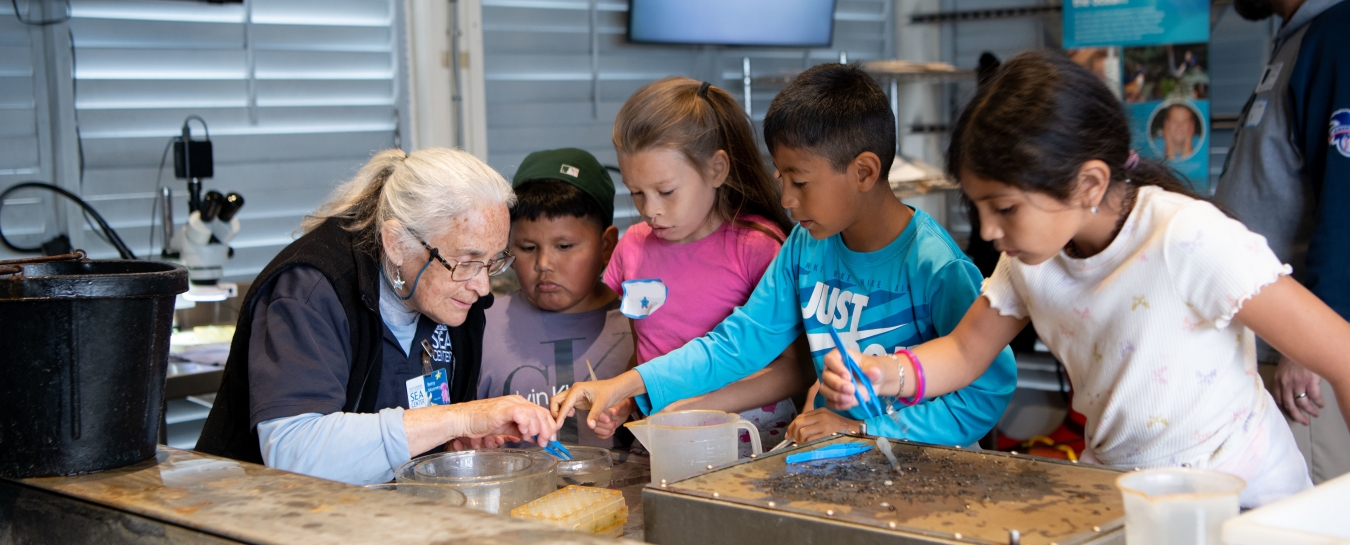
Marine organisms can live near or far from shore (nearshore vs offshore marine environments). Plankton are a group of organisms that are very important in the offshore marine environment. Plankton are very tiny and abundant and are an important food source for the pelagic organisms. This activity will explore the use of plankton tows, a common methos that scientists use to study plankton. Students will interact with monitoring gear and equipment, observe plankton under a microscope, or play games to help them understand how plankton tows work and what plankton looks like.
3rd Grade Lessons
Beach Lesson – Beach Wrack: The Secret Ecosystem at Your Feet
NGSS: 3-LS4-4, 3-LS2-1, 3-LS4-3
OLP: Principle 6 C.5, Principle 6 C.9
Key Topics: Beach wrack, food chains, producer, primary consumer, secondary consumer
Why is beach grooming harmful to local ecosystems? Students will use data they collect on the beach to understand the importance of beach wrack. They will use this information to fill out a food chain, identifying the producer, primary consumer, and secondary consumer in coastal ecosystems. By the end they will be able to explain why the removal of beach wrack reduces the presence of small beach dwellers such as beach hoppers, kelp fleas, and flies which are all important food to shorebirds. The activity for this lesson includes using interactive beach models to better understand food chains and ecosystem dynamics.
Patio Lesson- Protecting Healthy Kelp Forests
NGSS: 3-LS2-1, 3-LS4-4
OLP: Principle 5, Principle 6
Key Topics: Kelp forests, keystone species, biodiversity, habitats
There has been a large decline in kelp forests in California over the past ten years. Students will act as scientists to investigate this problem by collecting biodiversity data on different kelp forests models. By the end of the lesson, students will use their data to identify the problem and the solution to help protect our kelp forests. The activity for this lesson is to use a printed digital model of ecosystem dynamics to help visualize kelp forest ecology.
Patio Lesson- Abalone Advocates Modeling Population Management
NGSS: 3-LS4-4, 3-LS4.D
OLP: Principle 6C.5, Principle 6C.9
Key Topics: endangered species, keystone species, fisheries management, population management, overfishing
Abalone are marine snails that play a vital role in kelp forest ecosystems. In this lesson, students will explore the ecological importance of abalone, the history of white abalone fisheries in California, the impacts of overfishing on ecosystems and coastal communities, and the Sea Center’s role in broader efforts to restore wild white abalone populations. The activity for this lesson is for students to help read out abalone history through historical postcards and use marbles to simulate overfishing.
Patio or Beach Lesson- Make your Own Field Guide
NGSS: 3-LS4-2
OLP: Principle 5, Principle 6
Key Topics: Observation skills, biodiversity, species variation, organism identification
Students become naturalists by creating their own illustrated field guides while exploring the Sea Center. As they observe organisms, students draw what they see and record scientific observations including common names, species names, physical characteristics, and interesting facts. Students leave with personalized field guides that they can use while tide pooling.
Patio Lesson- Kelp Anatomy & Processes
NGSS: 3-LS1-A
OLP: Principle 4B, Principle 5A1, Principle 6A
Key Topics: kelp forests, structure and function, coastal ecosystems and habitats
Kelp forests are a vital part of the Santa Barbara coastal ecosystem. They create habitat for the fish and invertebrate species we depend on, produce more than half of the oxygen we breathe each day, and even appear as ingredients in many foods and cosmetics. Yet most people don’t realize how these remarkable protists are structured or how they function. This lesson introduces students to the similarities and differences between algae and plants and highlights why kelp forests serve as such an essential foundation species in our local environment. The activity for this lesson includes comparing algae and plants with peers and using kelp models to understand anatomy.
4th Grade Lessons
Patio Lesson- Sensing the Sea (Beyond the Five Human Senses)
NGSS: 4LS1-2
OLP: Principle 5B.1
Key Topics: five senses, biodiversity, electroreception, echolocation
Students experience the incredible diversity of senses animals have in marine habitats. By examining actual specimens, they will learn about the electroreceptors of sharks, the movement-sensing whiskers of sea lions, and echolocation used by dolphins, and how these unique senses aid in the survival of these marine creatures. Students even get the chance to experience sound waves similarly to the way that dolphins do!
Patio Lesson- Kelp Anatomy & Processes
NGSS: 4-LS1-1
OLP: Principle 4B, Principle 5A1, Principle 6A
Key Topics: kelp forests, structure and function, coastal ecosystems and habitats
Kelp forests are a vital part of the Santa Barbara coastal ecosystem. They create habitat for the fish and invertebrate species we depend on, produce more than half of the oxygen we breathe each day, and even appear as ingredients in many foods and cosmetics. Yet most people don’t realize how these remarkable protists are structured or how they function. This lesson introduces students to the similarities and differences between algae and plants and highlights why kelp forests serve as such an essential foundation species in our local environment. The activity for this lesson includes comparing algae and plants with peers and using kelp models to understand anatomy.
Patio or Beach Lesson- Make your Own Field Guide
NGSS: 4-LS1A
OLP: Principle 5, Principle 6
Key Topics: Observation skills, biodiversity, internal/external functions, organism identification
Students become naturalists by creating their own illustrated field guides before or after exploring the Sea Center. Using ID books , students draw what they see and record scientific observations including common names, species names, physical characteristics, and interesting facts. After spending time working on their field guide, the class reconvenes to discuss internal and external structures that function to support survival growth, behavior, and reproduction. Students leave with personalized field guides that they can use while tide pooling.
Patio Lesson- Plankton Is More Than Just A SpongeBob Character!
NGSS: 4-LS1-1
OLP: Principle 4, Principle 5, Principle 6, Principle 7
Key Topics: Pelagic ecosystem structure and function, plankton-driven food webs, biodiversity and productivity, pelagic species highlights and roles.
Marine organisms can live near or far from shore (nearshore vs offshore marine environments). Plankton are a group of organisms that are very important in the offshore marine environment. Plankton are very tiny and abundant and are an important food source for the pelagic organisms. This activity will explore the use of plankton tows, a common methos that scientists use to study plankton. Students will interact with monitoring gear and equipment, observe plankton under a microscope, or play games to help them understand how plankton tows work and what plankton looks like.
5th Grade Lessons
Beach Lesson – Sunflower Stars and the Balance of the Kelp Forest
NGSS: 5-ES3-1
OLP: Principle 6 C.7, Principle 5
Key Topics: endangered species, keystone species, trophic cascades
Students will be introduced to the sunflower star Pycnopodia helianthoides which many people in California are unaware of due to its rapid decline after the 2013 outbreak of sea star wasting disease. They will play a game to understand the role of sunflower stars as an important keystone predator in kelp forests. We will tie in the work the Sunflower Star Lab is doing to restore populations, dive into food chains and trophic cascades, and get students excited to see our sunflower stars at the Sea Center.
Patio Lesson- Kelp Anatomy & Processes
NGSS: 5-LS1-1
OLP: Principle 4B, Principle 5A1, Principle 6A
Key Topics: kelp forests, structure and function, coastal ecosystems and habitats
Kelp forests are a vital part of the Santa Barbara coastal ecosystem. They create habitat for the fish and invertebrate species we depend on, produce more than half of the oxygen we breathe each day, and even appear as ingredients in many foods and cosmetics. Yet most people don’t realize how these remarkable protists are structured or how they function. This lesson introduces students to the similarities and differences between algae and plants and highlights why kelp forests serve as such an essential foundation species in our local environment. The activity for this lesson includes comparing algae and plants with peers and using kelp models to understand anatomy.
Patio Lesson –Visualizing Food Webs
NGSS: 5-LS2-1
OLP: Principle 5A.20
Key Topics: Food webs, ecosystem balance, predator-prey relationships, competition, energy flow, ecosystem disturbances
Students participate in an interactive ecosystem modeling activity where each student represents an organism in the Santa Barbara Channel. Using colored strings to represent ecological interactions, students collaboratively build a physical food web model. Through guided discussion, students explore how organisms are interconnected and how disturbances can impact the entire ecosystem.
Patio or Beach Lesson- Make your Own Field Guide
NGSS: 5-LS2-1
OLP: Principle 5, Principle 6
Key Topics: Observation skills, biodiversity, food chain, organism identification
Students become naturalists by creating their own illustrated field guides before or after exploring the Sea Center. Using ID books , students draw what they see and record scientific observations including common names, species names, physical characteristics, and interesting facts. After spending time working on their field guide, the class reconvenes to discuss where they think different organisms fall on the food chain and why. Students leave with personalized field guides that they can use while tide pooling.
Middle School Lessons
Beach Lesson – SCUBA Quadrat and Transect Survey
NGSS: MS-LS2-3, MS-LS2-4, MS-LS2-5
OLP: Principle 5 B, Principle 6 E, Principle 7 B4
Key Topics: Biodiversity surveys, community science, transects/quadrats, SCUBA
Students learn how to use transect and quadrat surveys on the beach to mimic how scientists collect data underwater with SCUBA partners. This lesson highlights the importance of data collection, long-term monitoring, and citizen science for conserving biodiversity and sustaining a healthy ocean.
Beach Lesson –Marine Debris: What Will We Find?
NGSS: MS-ESS3-2 MS-ESS3-3
OLP: Principle 6 D, Principle 6 D .22, Principle 6 D.20, Principle 6E. 12
Key Topics: Marine debris, citizen science, transects, invasive species
Students will learn about what marine debris is and the different forms it comes in and sources that generate it. They will then use that knowledge to come up with a hypothesis about what type of marine debris will be most common on East Beach. They will then conduct a beach cleanup where they record data on what they find and then they will come to conclusions about what the main sources are in Santa Barbara and how they can reduce their impact on the issue.
Patio Lesson –Visualizing Food Webs
NGSS: MS-LS2-1, MS-LS2-3
OLP: Principle 5A.20
Key Topics: Food webs, ecosystem balance, predator-prey relationships, competition, energy flow, ecosystem disturbances
Students participate in an interactive ecosystem modeling activity where each student represents an organism in the Santa Barbara Channel. Using colored strings to represent ecological interactions, students collaboratively build a physical food web model. Through guided discussion, students explore how organisms are interconnected and how disturbances can impact the entire ecosystem.
Patio Lesson- Kelp Anatomy & Processes
NGSS: MS-LS1-6
OLP: Principle 4B, Principle 5A1, Principle 6A
Key Topics: kelp forests, structure and function, coastal ecosystems and habitats
Kelp forests are a vital part of the Santa Barbara coastal ecosystem. They create habitat for the fish and invertebrate species we depend on, produce more than half of the oxygen we breathe each day, and even appear as ingredients in many foods and cosmetics. Yet most people don’t realize how these remarkable protists are structured or how they function. This lesson introduces students to the similarities and differences between algae and plants and highlights why kelp forests serve as such an essential foundation species in our local environment. The activity for this lesson includes comparing algae and plants with peers and using kelp models to understand anatomy.
High School Lessons
Beach Lesson –Observing Group Dynamics
NGSS: HS-LS2-6, HS-LS2-8
OLP: Principle 5C.37
Key Topics: Community ecology, predator-prey interactions, group behavior, survival strategies
Students participate in an active simulation exploring predator-prey interactions and the ecological advantages of group behavior. Volunteer students act as marine scientists wearing SCUBA gear while observing and recording patterns during two predator-prey scenarios. Through comparison of individual versus group movement, students analyze how behavior influences survival and discuss how similar strategies are used by organisms in marine ecosystems.
Patio Lesson –Becoming A Marine Scientist
NGSS: HS-LS4-5, HS-LS4-6, HS-LS1-3
OLP: Principle 6E, Principle 7A,7B,7C
Key Topics: Forming research questions, collecting and testing data, evaluating results
Students explore the Sea Center and choose an organism to observe, recording notes, questions, and interesting discoveries like marine scientists. Using their observations, they develop a research question, form a hypothesis, and identify key variables needed to investigate their idea. The experience concludes with students sharing their research concepts and reflecting on the process of observing, questioning, and thinking like scientists.
Beach Lesson –Marine Debris: What Will We Find?
NGSS: HS-ESS3-4, HS-ESS3-2
OLP: Principle 6 D, Principle 6 E.5
Key Topics: Marine debris, citizen science, transects, invasive species , microplastic
Students will learn about what marine debris is and the different forms it comes in and sources that generate it. They will then use that knowledge to come up with a hypothesis about what type of marine debris will be most common on East Beach. They will then conduct a beach cleanup where they record data on what they find and then they will come to conclusions about what the main sources are in Santa Barbara and how they can reduce their impact on the issue
 Click here to start booking.